Sitecore Symposium 2025: Modernizing Shriners Children's Digital Experience
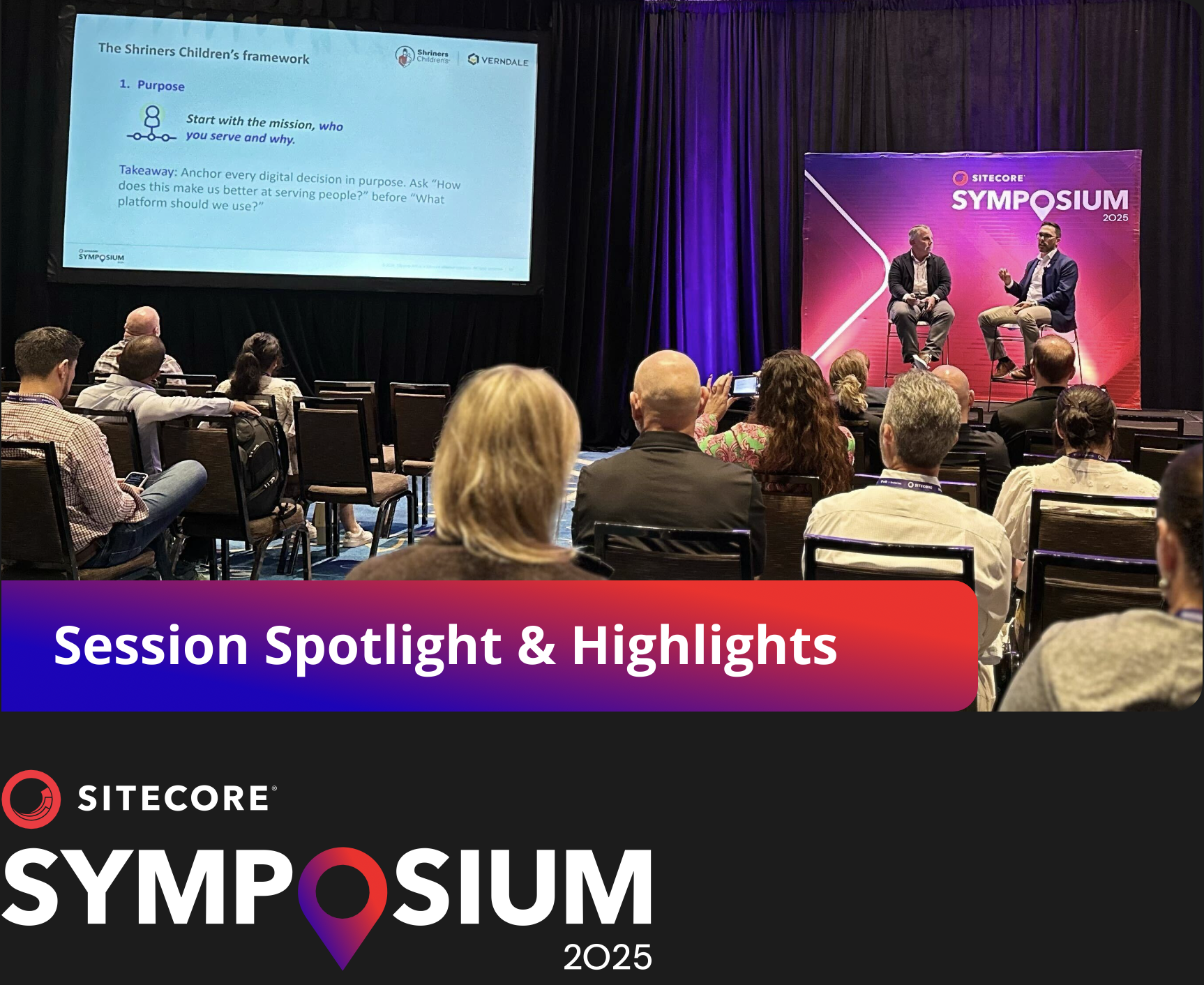
Tod Szewczyk and Anthony Watts seated on stage in a fireside-chat format at Sitecore Symposium 2025, with an audience watching in the foreground and a presentation slide titled "The Shriners Children's framework" displayed on screen beside them.
Joined Anthony Watts, Digital Marketing Director at Shriners Children's, on stage at Sitecore Symposium 2025 to discuss how Shriners Children's is modernizing its patient and donor digital experience on Sitecore XM Cloud. We covered why mission and message have to align before growth follows, why the "digital front door" has to open flawlessly when every click could lead to care, and why a stable platform needs to support patients and the people behind the mission at the same time.
We walked through Shriners Children's full journey to get there. Before 2018, the organization had a limited digital footprint and a "free equals low quality" perception problem to overcome. Its first-ever ad campaign and 2019 website remediation generated more leads than the system could handle, which led to the 2022 relaunch of ShrinersChildrens.org and an eventual migration off a fragmented legacy platform onto XM Cloud to support their Vision 2035 roadmap. We closed with the three-part framework that guided the transformation: start with Purpose, anchoring every platform decision in who you serve and why before deciding what technology to use; build the Platform for where the organization needs to be three years out, not just where it is today; and keep People, patients, donors, and the staff behind the mission, at the center, since the technology is there to amplify impact, not to be the point of the exercise.
Work: From Blog to Lab: How Leovative Grew Into an Innovation Practice at Leo Burnett
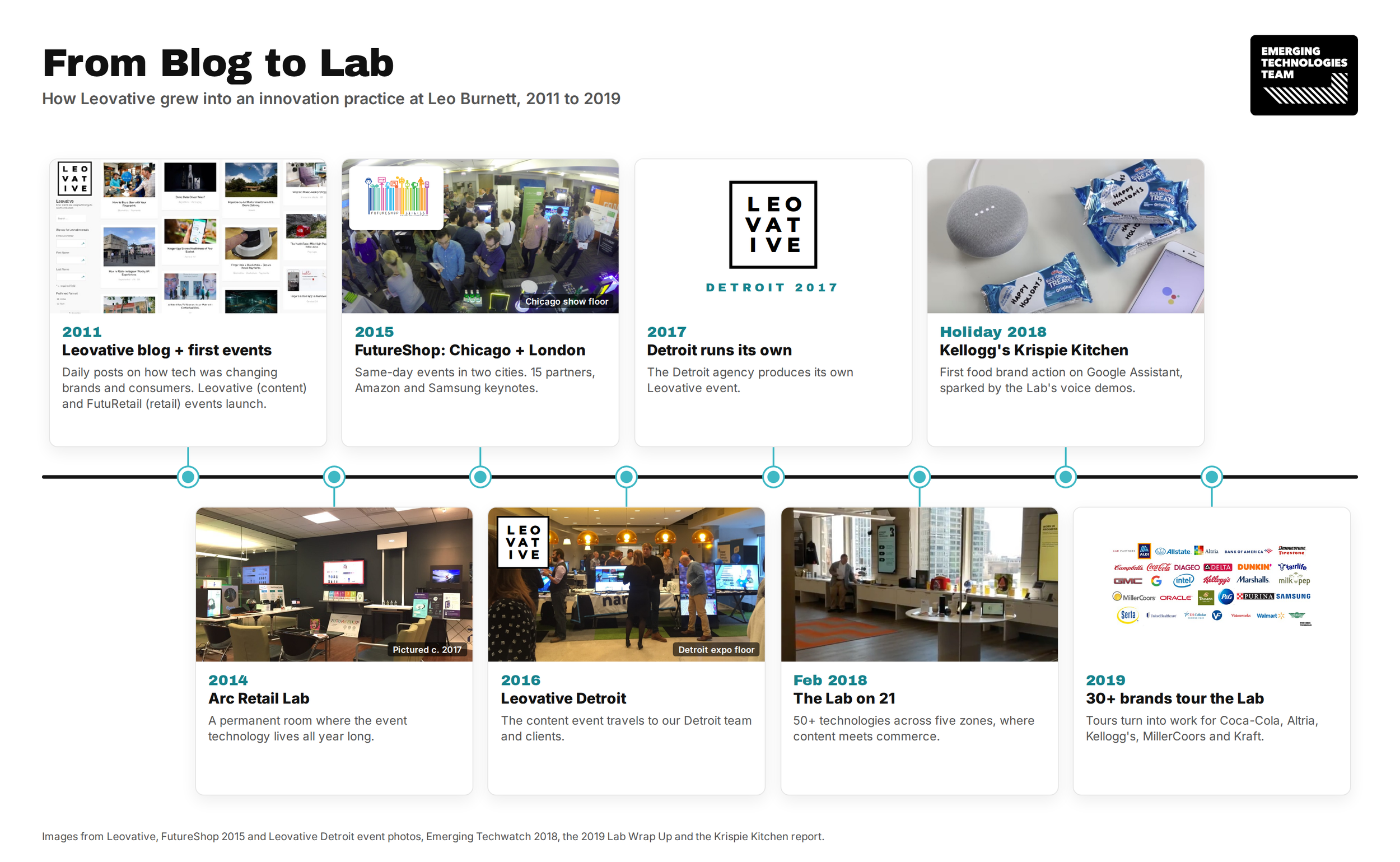
Most innovation programs start with a big launch and a mandate from the top. Ours started with a blog and an idea I believed in. Between 2011 and 2019, I grew a small side project at Leo Burnett and Arc Worldwide into a funded innovation practice. First came a daily blog. Then came events twice a year, then a retail lab, and finally a full innovation lab that won new work for the agency. The lab was the goal from day one. It just took time to get there.
Step 1: The Leovative Blog (2011)
I started Leovative in 2011 as part of the first innovation event I produced at the agency. The idea was simple. Post an update every day on how technology was changing the relationship between brands and consumers. That could be a new retail concept, a smart package, a voice experience, or a store that felt more like a showroom than a place to buy things.
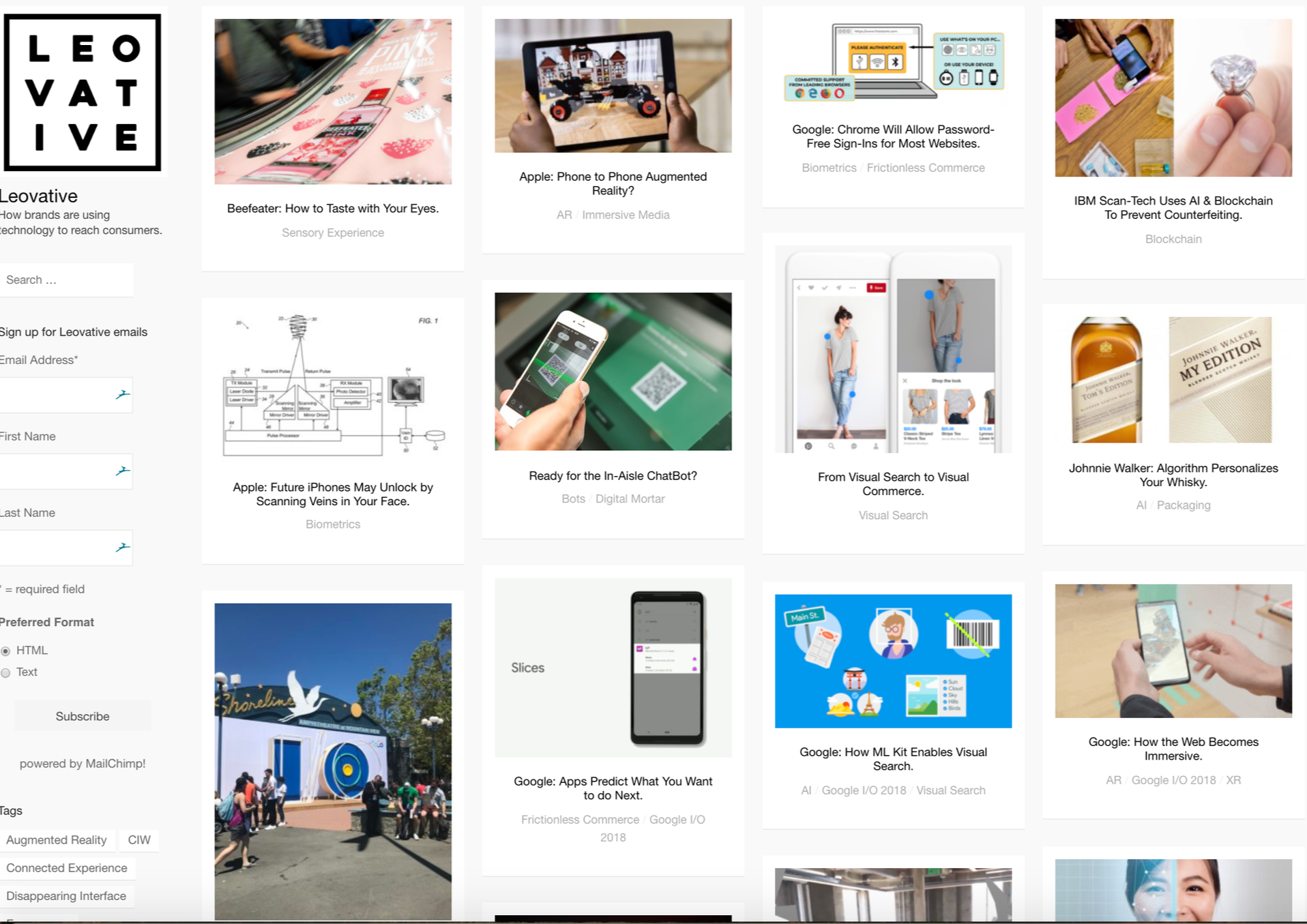
The Leovative site: eight years of daily posts on how brands were using technology to reach people in new ways.
Over time it became a newsletter, sent two to four times a week to clients and to our offices around the world. It ran for more than eight years. Near the end, our UK team was testing Leovative content in Marcel, Publicis Groupe's internal platform, with plans to bring it to North America. The blog did two things for us. It kept the agency looking around the corner. It also gave us a steady stream of material for everything that came next.
Step 2: The Events (2011 onward)
The blog led to live events. We produced two a year:
Leovative: the content event, named after the blog
FutuRetail: the retail event
FutuRetail turned out to be the stronger of the two, and it became the one clients asked about.
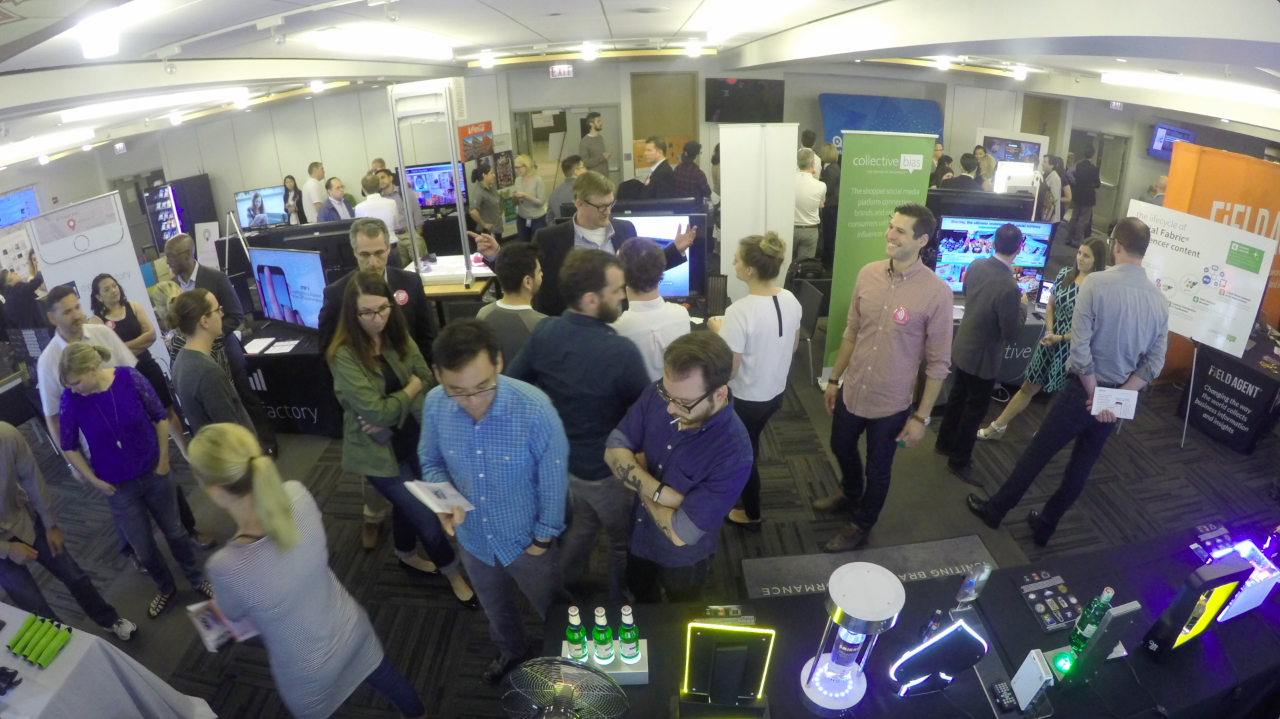
FutureShop 2015 in Chicago: clients, partners and agency teams on the expo floor, the same day we ran the event in London.
Step 3: The Arc Retail Lab (2014)
After a few years of FutuRetail events, one thing was clear. Clients wanted to see and touch the technology any time, not just on event day. So in 2014 we built the Arc Retail Lab, a permanent room where the retail technology from our events and our blog could live all year long.
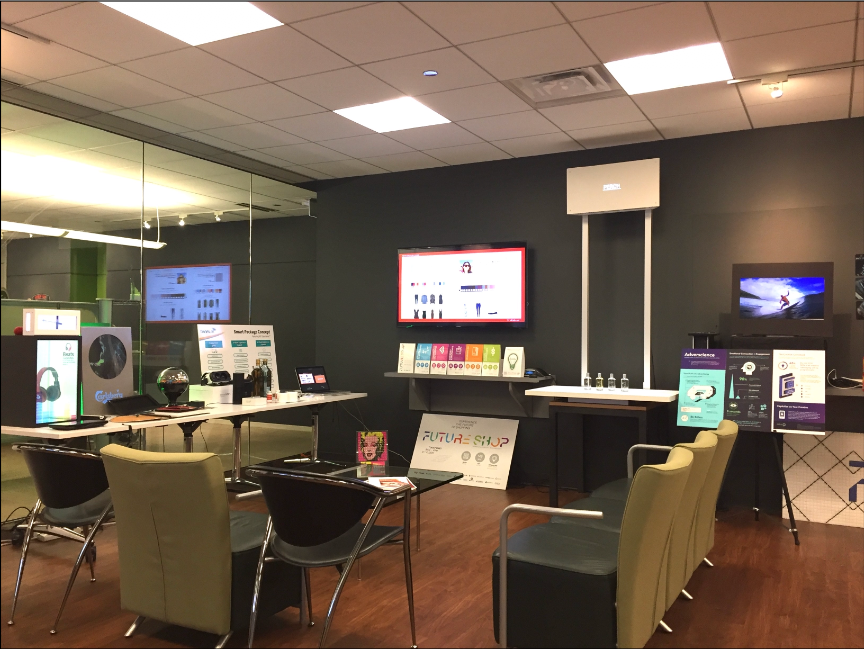
The Arc Retail Lab, circa 2017: a permanent home for the retail technology from our events, open to clients all year long.
It became our testing ground. We could show a client a smart shelf or an NFC tag on a package instead of just describing it. We also started building our own prototypes there.
Step 4: The Events Travel (2015 to 2017)
The events kept growing alongside the lab. In 2015 we renamed FutuRetail to FutureShop to put the focus on the shopper, and we took it global. We held FutureShop in Chicago and London on the same day, June 11, 2015. The London event was at the Vinyl Factory in Soho.
The FutureShop 2015 logo: a barcode made of shoppers and devices, dated 11·6·15 for the same-day events in Chicago and London.
Here's what the London day included:
15 technology partners on an expo floor, each chosen to fit a single theme: how brands can reduce friction and connect with shoppers through the five senses
Keynotes from Amazon and Samsung
A round of "20x20" talks, where each partner had 20 slides at 20 seconds a slide
An Arc zone showing our "Me Commerce" approach to shopper marketing, including shoppable video from Smartzer and touch-screen tables from Media Zest
About 60 clients and prospects, 120 agency staff, and 25 press and industry guests
Across both cities, the #futureshop2015 hashtag had more than 300 mentions and over 700,000 views. One agency leader summed up the day this way: "Arc really demonstrated its competitive advantage yesterday and our clients took notice."
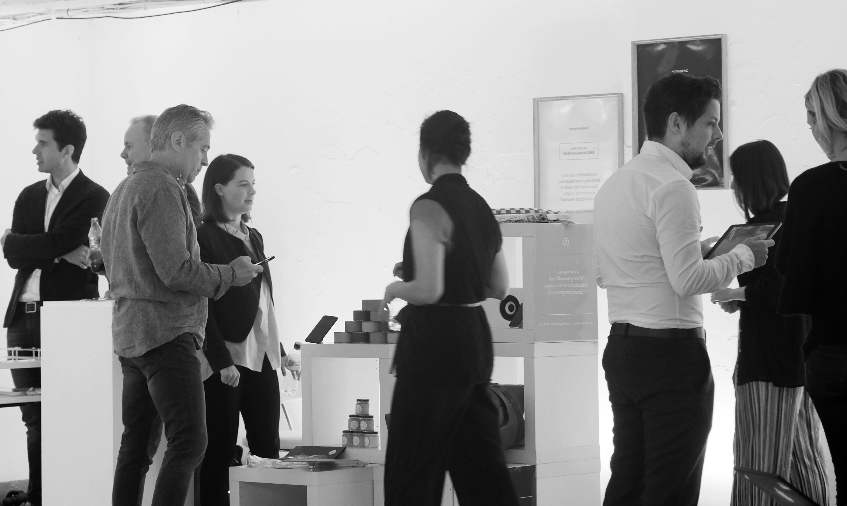
FutureShop London, 2015: Provenance founder Jessi Baker and fashion and lifestyle expert Neliana Fuenmayor demo tools for supply chain transparency at the Vinyl Factory. Photo: Provenance
The content side traveled too. In 2016 I produced a Leovative event in Detroit, bringing the same format to our team and clients there. The next year, the Detroit agency produced its own Leovative event without us. That was one of the clearest signs the program was working. It had become something other teams wanted to run for their own clients.
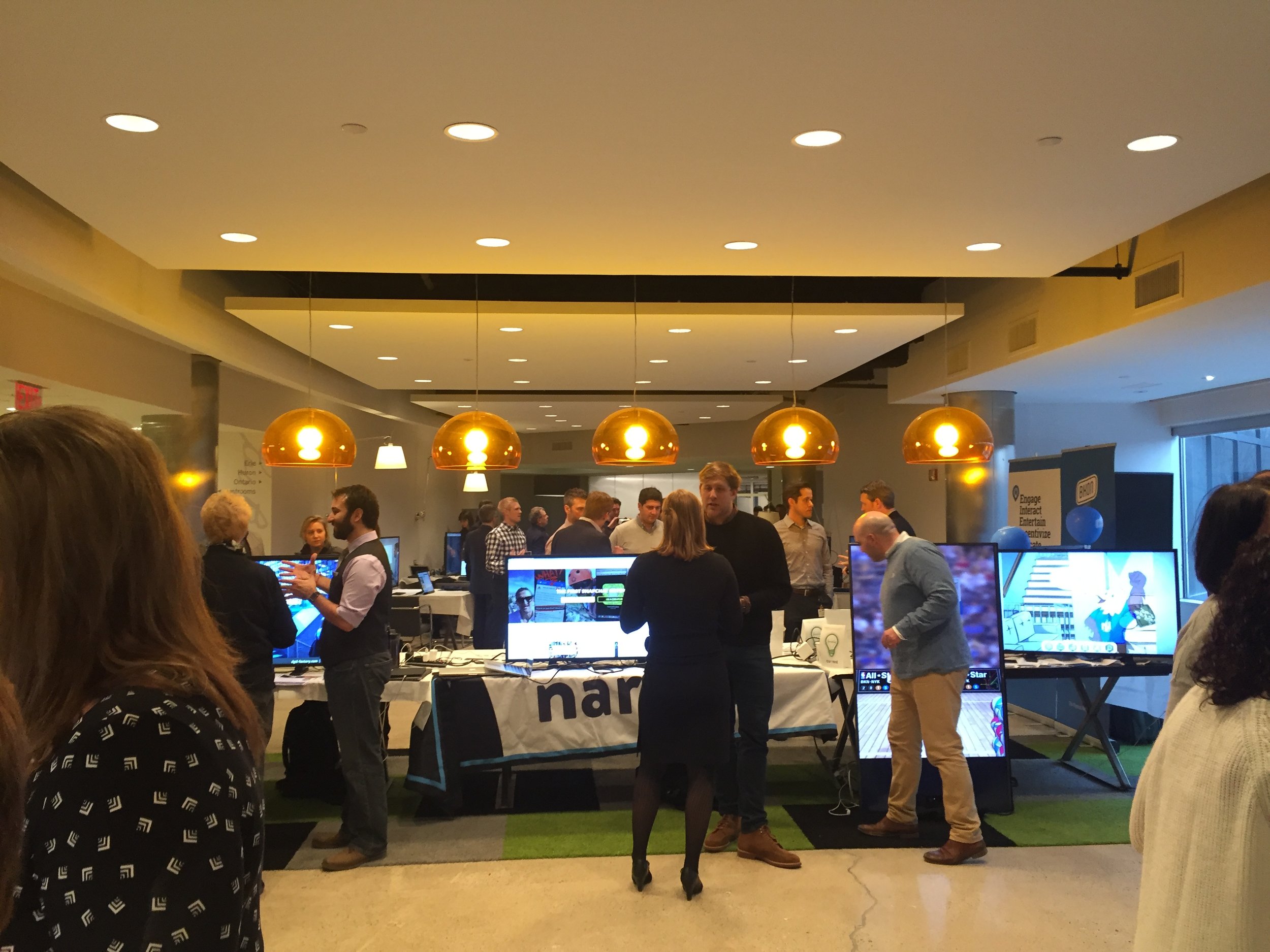
Leovative Detroit, 2016: bringing the content event to our Detroit team and their clients.
The biggest lesson from these years was about focus. Pick one clear theme early and stick with it. That lesson carried straight into how we built the next lab.
Step 5: The Lab on 21 (2018 to 2020)
In February 2018 we opened the Lab on 21. It was a much bigger space with a broader mission. We moved from retail alone to the place where content and commerce meet in advertising, which brought the themes of our Leovative and FutuRetail events together in one room.
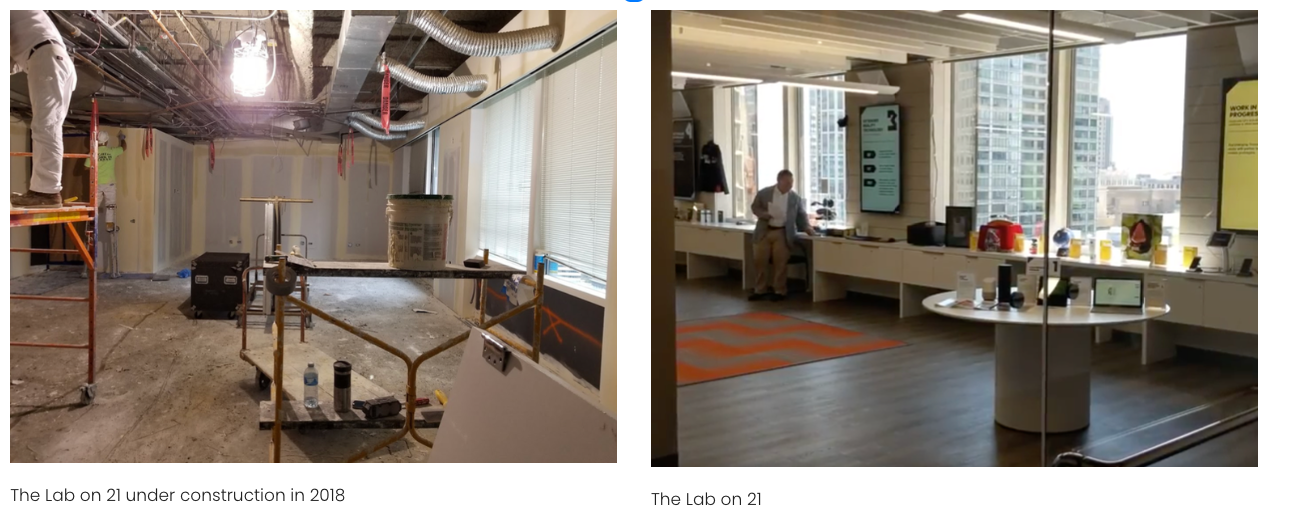
The Lab held more than 50 pieces of technology across five areas: Conversation, Works in Progress, Extended Reality, Frictionless, and Retail. Every area included at least one prototype our Emerging Technology team built. One of them was LC, our "Lab Curator," which worked as a Google Assistant Action, a Facebook Messenger bot, and an ARKit shopping guide. Another was the Redeem Machine, a vending machine that gave you one free snack for every 30,000 steps. More than 400 employees downloaded the app, and we refilled the 400-item machine 10 times in two months.
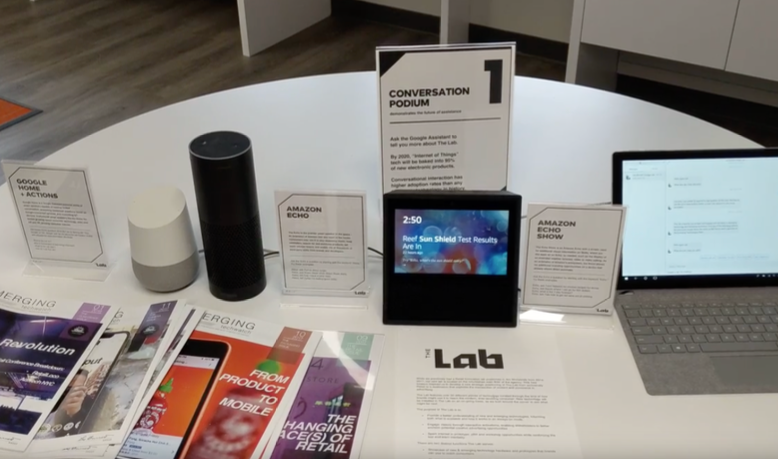
We created a conversational agent, LC, to explain the Lab (in 2018).
Walk through of The Lab on 21
The Value It Brought
By 2019 both labs had paid off in new business. More than 30 brands toured the Lab on 21, including Coca-Cola, P&G, Walmart, Samsung, Google, Kellogg's, Intel, and MillerCoors. The labs turned into real work:
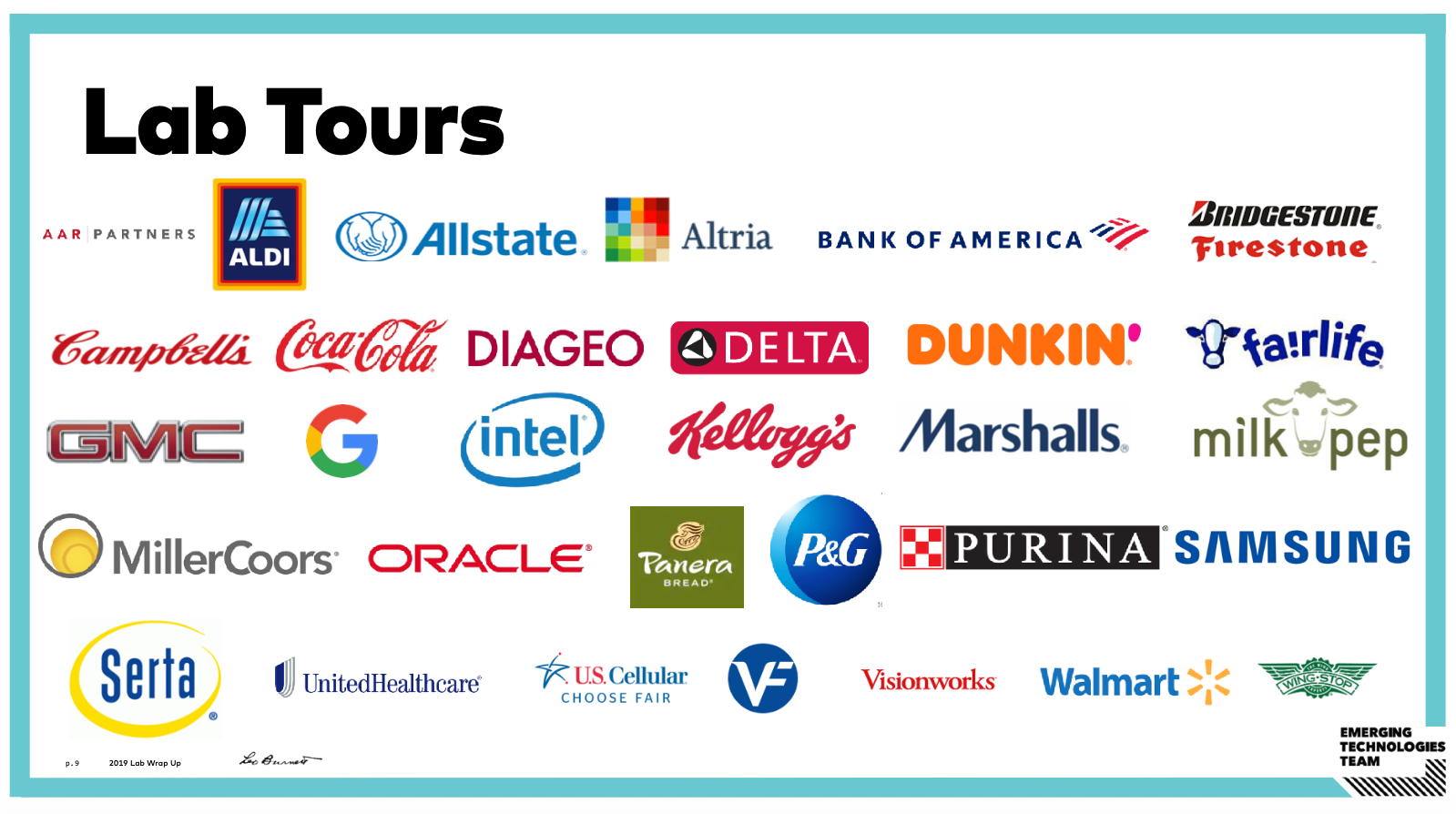
Companies and clients that toured the lab in 2019
Coca-Cola hired us to help build a "Future of Commerce" space inside its KO Lab in Atlanta. We worked alongside their design firm, Gensler. A Coca-Cola shopper marketing leader explained why: "Coke has a great innovation lab and we are looking to build a space within the space to highlight digital innovation. And, of course Arc has already built out a space that does just this! So, why should we recreate the wheel when we could partner with you to help us envision our space to be cool like yours?"
Altria: what we learned about technology and shopper behavior in the Retail Lab shaped an AI-driven mobile loyalty program for Altria that grew to 5 million monthly engagement events. Later, a Lab on 21 tour and workshop with Rokkan led to an unmanned retail kiosk idea for IQOS, using a biometric vending machine from the Lab.
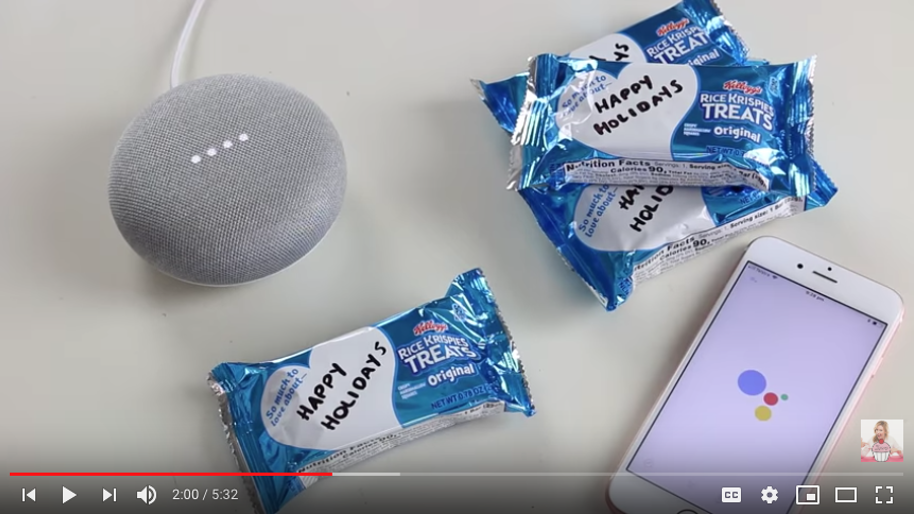
Kellogg's launched Krispie Kitchen for the 2018 holidays. It was the first food brand action on Google Assistant, and the first campaign built in full partnership between Google and Kellogg's. The idea came from the voice demos in the Lab. It came to life through the Google and Leo Burnett partnership, which I led. Families used their voices to make Rice Krispies Treats while listening to holiday stories with narration and sound effects. The treats turned into edible holiday art along the way. Three YouTube creators, My Cupcake Addiction, Trav & Cor, and Daily Bumps, demoed the experience. The whole thing went from sold to launched in 11 weeks. The results:
Over 9 million ad impressions and 1.7 million video views
A 19.6 million reach through the creators
A 6.9% lift in ad recall among parents, and a 3.6% lift in consideration, a metric that is hard to move
Click-through rate more than double the food brand average (0.18% vs. 0.08%)
About 2,500 active users who spent almost two minutes per session, double the one-minute benchmark
Base sales that went up over the holiday period
MillerCoors hired the Emerging Technology team to tackle out-of-stock problems at large retailers. That came straight out of a lab tour. Separately, a digital end cap concept we built with lab technology went live in a store in Texas.
Kraft: we built an Alexa voice prototype for a pitch and ran it live in the room. Arc won the pitch.
We also formed the Innovation Collective, an informal network of innovation and emerging technology leads across the agency's network who shared resources and built prototypes together.
Looking Back
The lab was always where I hoped this would lead. From the early days of the blog, I pictured a permanent space where clients could see and touch what was coming next. The blog built a point of view, and the events built an audience. Each step made the case for the next one.
It wasn't a role anyone handed me. Nothing quite like it had been done at the agency before, so I shaped it as I went. Over time it earned its own budget and grew to about half of my full-time role at Leo Burnett.
Building something new inside a large agency takes patience. There were plenty of moments when the easier path was to keep doing things the way we always had. What stays with me is that leadership kept saying yes. I think they saw it as a bet on where creativity could go, even before any of us knew exactly what it would become. Their willingness to make that bet, year after year, meant a great deal to me and to the team.
The same idea still drives how I work today. Technology only matters when people can see it, try it, and picture what it could do for them. Sometimes the best thing you can do is build that picture early and invite others to see it with you.
Collaborators: Nick Jones, Jim Carlton, Darren Norkett, Joe Duncan, Kevin Babcock, Lisa Gillis, Danny Ryback, Justina Nguyen, Kent Weber, Ben Oberc.
Consolidating a fragmented digital ecosystem at a multi-hospital academic health system
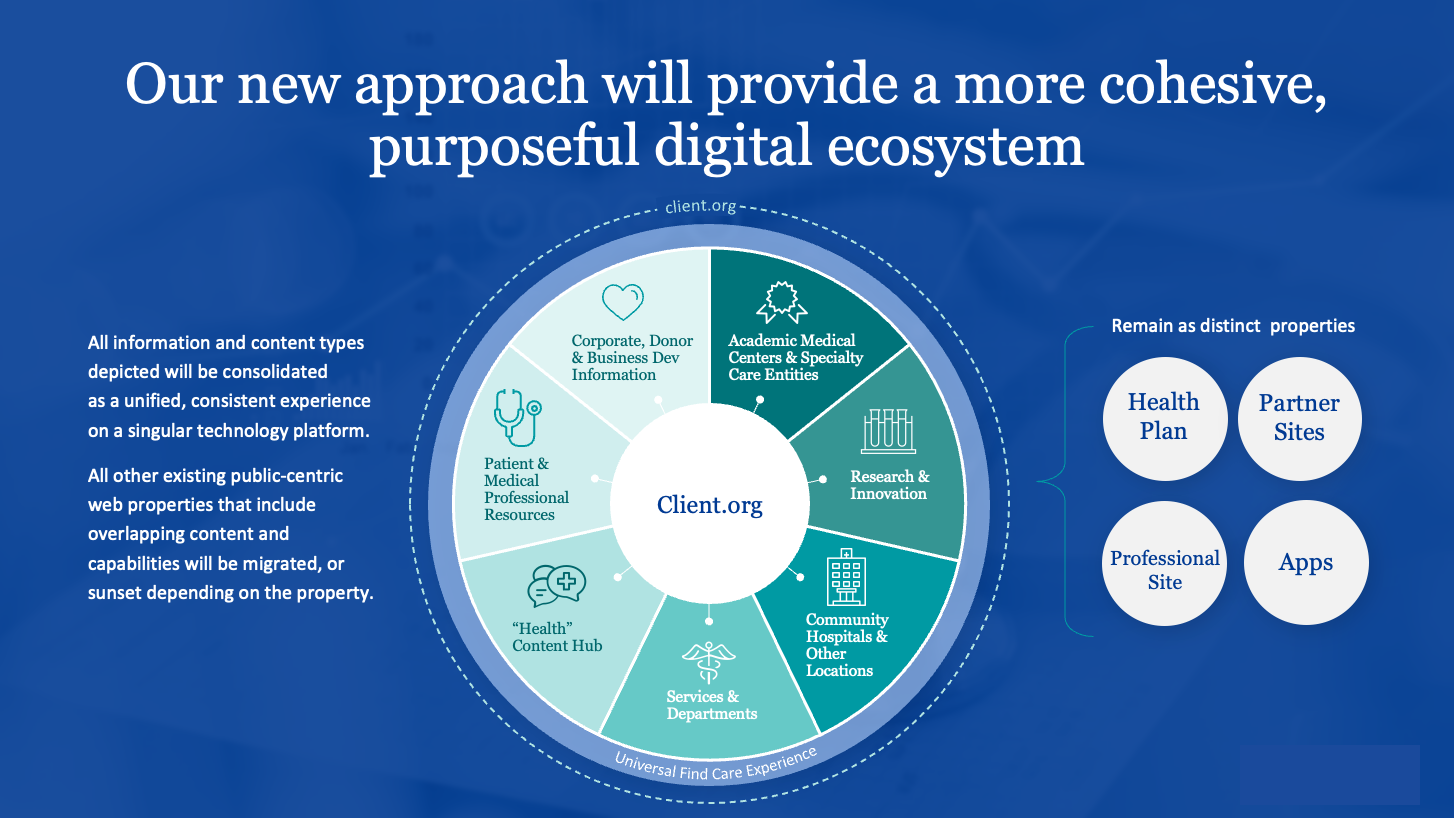
A wheel diagram showing a central "Client.org" hub surrounded by seven consolidated content areas (academic medical centers, research, community hospitals, services, patient resources, and more), with four properties, Health Plan, Partner Sites, Professional Site, and Apps, shown remaining independent alongside it.
While at Perficient, I led the digital strategy engagement for a large academic healthcare system with dozens of hospitals, research institutes, and specialty care entities, each running its own website on its own technology platform. The result was a fragmented patient experience: inconsistent branding, duplicate content competing against itself in search, and no shared way to measure or improve digital performance across the system. I advised the C-suite on a path to a modern, integrated web experience, building the business case, defining the objectives and key results, and evaluating what the future website architecture should actually look like.
The core question was structural: should the organization move to a single unified site, a network of interconnected properties, or keep everything independent. We built a weighted decision framework around the criteria that actually mattered here, brand consistency, patient experience, regulatory and contractual constraints, and cost of change, and used it to recommend a hybrid model: consolidate the majority of digital properties into one system-wide experience, while preserving a small number of sites independently where there was a genuine business, legal, or regulatory reason to do so. That recommendation became the foundation for a multi-year roadmap covering everything from unified UX and content strategy to the underlying technology stack.
Work: Elkay's Virtual Neighborhood
I led digital strategy and development on this project which launched as a virtual event for Elkay at the 2021 Kitchen and Bath Industry Show. The development partner on this was Groove Jones, the content below is from their post about the project. The site is still live, access here. As a note, you will need to register to gain access. Similar to the Yale project listed below, this experience consisted of two sites linked together, an event site built on Swoogo and the immersive site built with WebGL. To read more, visit August Jackson’s site here. The project has garnered 3 awards to date, a Bronze in the Best Metaverse/Immersive Experience and a Silver in the Best Pandemic-Era Transformation categories from Event Marketer Experience Design and Technology Awards 2022. The project also won a Award of Excellence in the visual appeal and aesthetic category from the Communicator Awards.

Site Start Page
When Conferences Go Virtual – Elkay Goes Digital With Interactive Web Exhibit for Their Latest Product Demos.
In 2021, KBIS (Kitchen Bath Industry Show), North America’s largest trade show dedicated to all aspects of kitchen and bath design, went virtual due to the COVID-19 pandemic. August Jackson, the agency for Elkay Manufacturing, was recognized last year by KBIS with the exhibition’s Best Large Booth Award. The “Elkay Neighborhood” exhibition, created for the 2020 event, showcased a 9,000-square-foot installation with designs from over 600 brands. August Jackson turned to Groove Jones to help them turn their award-winning concept into a bigger-than-life digital experience for 2021.
Elkay launched the Virtual Neighborhood as part of KBIS Virtual. The site features a digital neighborhood with five unique houses where customers can tour the latest Elkay products and interact with them in meaningful ways.
The Virtual Neighborhood is being promoted via direct mail to their customers and on the Elkay website, along with highlights of their latest product announcements, project tools, and live event links.
The neighborhood comprises five primary houses that can be explored, surrounded by various other homes. Visitors to the site use their mouse to move around. The setting is animated and will parallax giving the world depth as they move around.
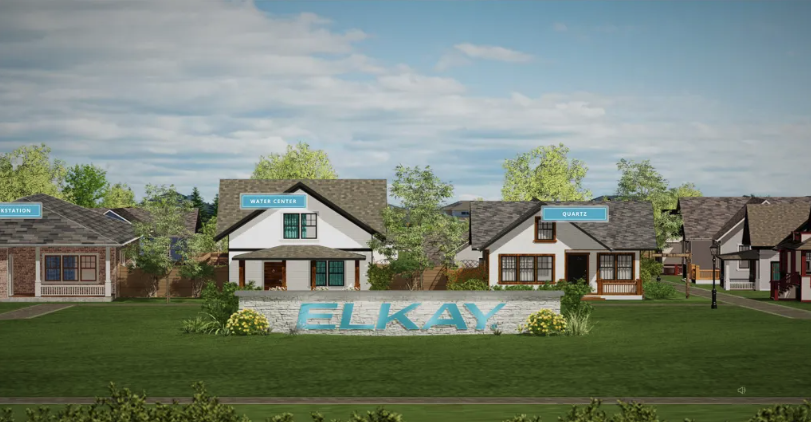
Parallax Neighborhood Experience

The Workstation House
The Workstation House features three sink product lines – Crosstown Stainless, Fireclay, and Quartz paired with various kitchen faucets. Each product SKU featured a unique, beautifully rendered kitchen with interactive hot spots that allow visitors to tap and view product info, watch product videos, browse an image gallery and save the SKU to their user profile.


ezH2O LIV® House
The ezH2O Liv® House features the ezH2O Liv®, a filtered water dispenser designed to fit any space seamlessly. Within multiple areas in the house. The rooms that included a foyer, office, playroom, and laundry have interactive hot spots that allow visitors to tap and view product info, watch product videos, and save the SKU to their user profile.

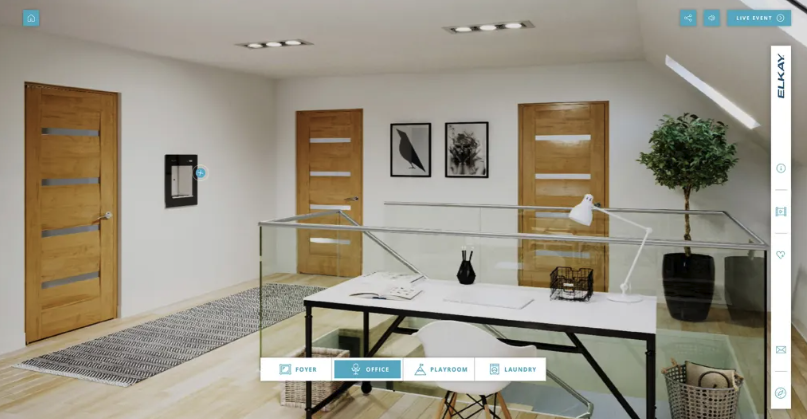

This house included an interactive mode where customers can tap and view the different ezH2O LIV® color options available.
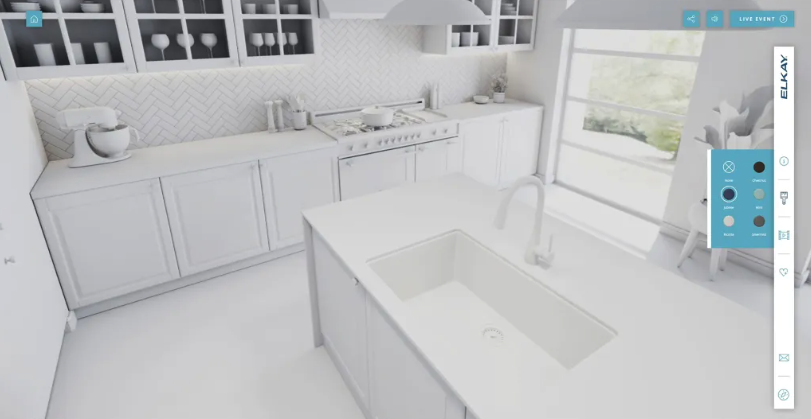
Quartz House
The Quartz features the Elkay Quartz Luxe® sinks, where you can add color to your kitchen! This fully interactive house allows the visitor to customize the kitchen and select five different color options for the Elkay Quartz Luxe® sinks. Each product SKU features a unique, beautifully rendered kitchen with interactive hot spots that allow visitors to tap and view product info, watch product videos, browse an image gallery and save the SKU to their user profile.


The Dart Canyon™ House
Dart Canyon™ is a testament to Elkay’s passion for ingenuity. This house features a new dynamic sink that is ADA-compliant. The kitchen includes interactive hot spots that allow visitors to tap and view product info, watch product videos, browse an image gallery and save the SKU to their user profile.
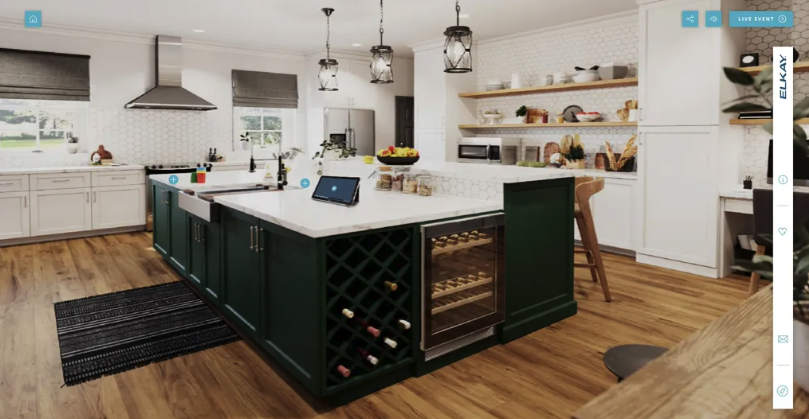
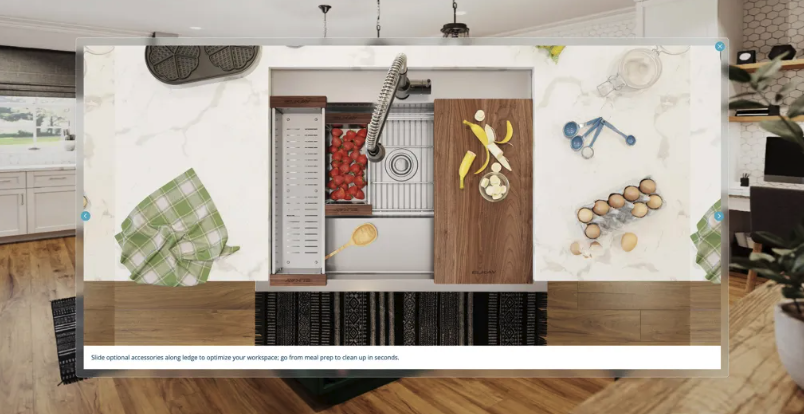


The experience recently won the Event Marketer, Experience Design & Technology Award – Best Metaverse/Immersive Experience.
Opening Yale's Gates to the World: The Virtual Platform Behind the For Humanity Campaign Launch
The opening montage welcomed virtual guests as gates across Yale's campus swung open.
On October 2, 2021, Yale University publicly launched For Humanity, a $7 billion capital campaign. In a normal year this would have been a big gathering in New Haven. In 2021, with the pandemic still limiting travel and crowds, most of the audience had to join online. Yale wanted those people to feel like they were on campus, not just watching a stream.
While I was EVP, Digital Engagement at August Jackson, I led the virtual platform strategy for our winning pitch. I then led the development and delivery of that platform for the launch event. A large production team made the broadcast happen. My part was the digital experience: everything a guest saw, clicked and explored from their own screen. For most of the audience, that platform was the event. It is how 5,000 people around the world were able to attend.
The Challenge
The launch event was a three-hour broadcast from the Yale Schwarzman Center that mixed live and prerecorded segments. It featured President Peter Salovey, the campaign co-chairs, faculty, narration by Angela Bassett, and a closing performance by Pentatonix with Kevin Olusola. Guests joined from Hong Kong, London, Beijing, Kenya, Beirut, Argentina and many other places.

The broadcast stage in the Schwarzman Center's Commons. Production ran from here, while most guests joined from around the world through the virtual platform.
Our job was to make sure a distant audience felt connected to the place and to each other, and could keep exploring after the broadcast ended.
What We Built
We launched two sites together:
An event hub on the Swoogo platform to handle registration and carry the livestream, including a portal for 15 separate streaming broadcasts.
An immersive companion site that brought the Yale campus to visitors who could not travel there.
To build it, I brought in Current Studios, a digital studio with more than fifteen years of experience creating immersive AR and AI experiences for brands, as our development partner. Current was a partner I started working with at Leo Burnett and participated in the FutuRetail and Leovative events, built an AR prototype for The Lab on 21, and client work.
The event home page connected guests to the livestream, the Global Commons, the virtual campus and the photo booth.
Inside the experience, guests could:
Explore a virtual campus. Spaces like the Tsai Center for Innovative Thinking were filled with clickable stories about the research and people behind the campaign.
Take 360-degree video tours of campus locations.
Get content recommendations pointing them to related themes and dialogues, such as innovation and social enterprise.
Use a custom photo booth with Yale backgrounds, frames and stickers. Filling out a profile unlocked more graphics, which gave people a reason to engage more deeply.
Connect in the Global Commons, a private social networking space for the Yale community.
Clickable stories placed throughout campus spaces let guests explore the work behind the campaign.
360-degree video tours brought guests inside campus during the pandemic.
The custom photo booth let guests create and share Yale-branded photos.
The whole experience was built to be WCAG compliant, so it worked for the full Yale community, not just part of it.
Results
33,000 visits to the campaign website
5,000 attendees from around the world
71 days' worth of content viewed during the three-hour event
The project went on to win Best Live Streaming and Video Production at the 2022 Event Technology Awards. In March 2022, I joined colleagues from August Jackson at the CASE District I Conference in Boston to share what we had learned about virtual and hybrid engagement, with this project as a key example.
What I Took Away
A virtual event is not a livestream with a chat box. It works when you treat the audience's screen as the venue: give people places to go, reasons to stay, and ways to find each other. The broadcast had a start and an end. The platform let people keep exploring on their own terms.
The event platform has since been archived. You can see elements of it on August Jackson's website and in this video from Yale's Office of Development talking about the project.
Thanks to the Yale Office of Development, the full August Jackson production, creative and design teams, and our development partners at Current Studios who brought this event to life.
Passion to Power Podcast
I was honored to be a guest on Michelle Zeitlin’s Passion to Power podcast in September 2021. You can listen to our conversation covering Hybrid Events here.

A FIELD GUIDE TO VIRTUAL EVENT PLATFORMS: CHAPTER 3 – VIRTUAL IMMERSION PLATFORMS
This post was part of a content series I wrote in 2020 & 2021 at August Jackson looking at the virtual event platform space. Chapter 3 covers virtual immersion platforms and a look ahead at what Hybrid Events might become, circa April 2021.

In Chapter Three of the Field Guide to Virtual Event Platforms, we start with a quote from Benedict Evans, noted independent analyst and former partner at Andreesen Horowitz, who wrote “…Every time we get a new tool, we start by forcing it to fit the old way of working, and then one day we realize that it lets us do the work differently, and indeed change what the work is.” It’s a prescient quote that sets the stage for this article on Virtual Immersion Platforms.
At AJ, we define Virtual Immersion Platforms as cloud-based event software that attempts to recreate the live event/conference setting with a simulated lobby, keynote theater (for live, simulive, and pre-recorded content), virtual tradeshow booths and networking centers.
As we noted in Chapter One, the Virtual Event space is undergoing fundamental changes that will last for next few years due to the pandemic. In March 2020, Virtual Immersion platforms gained in popularity due to the fact that they recreated places that we couldn’t gather in and made 100% sense as a way to ground attendees in the event dynamic. In Chapter Two, we looked at Virtual Experience platforms across the three stages of an event, pre, during and post. For Virtual Immersion platforms, we will think about the experiences in layers, not stages. This layered approach was inspired by the November 2020 6Connex Webinar, “Plotting your Virtual Event Strategy for 2021-and Beyond” with 6Connex CEO Ruben Castano, Wainhouse Research Senior Analyst Steve Vonder Haar, and Joakim Jonsson, GM 6Connex EMEA. In the webinar, they talk about the three layers of virtual events: Visual, Interactive and Data.
THE VISUAL LAYER OF VIRTUAL IMMERSION PLATFORMS
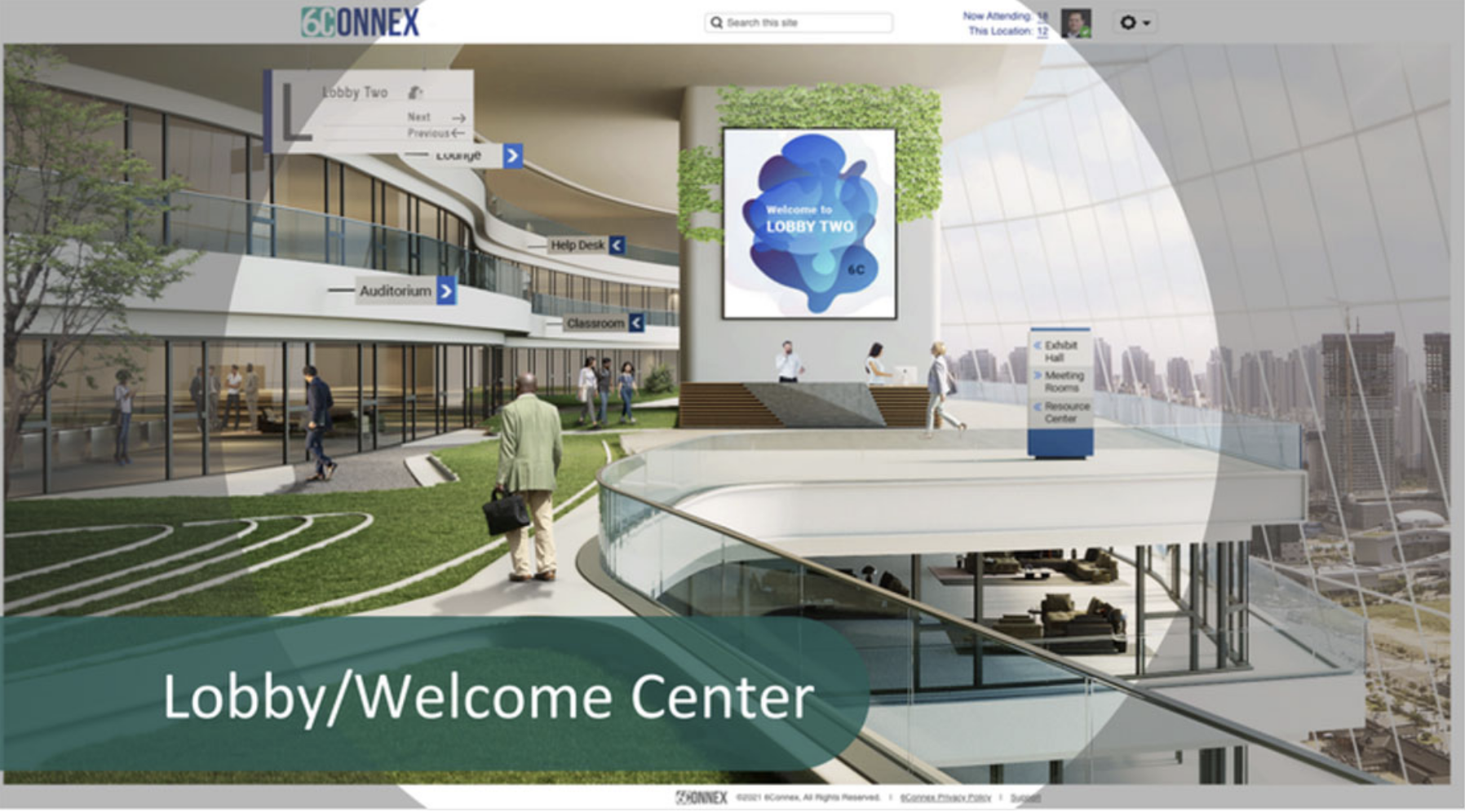
6Connex Lobby via The Blueprint
To begin, the visual layer of Virtual Immersion Platforms contains two elements, the presentation of the space and then the video stream where the content lives. The presentation of the space is where there are significant differences. On one side, there are the platforms that create virtual lobbies that are approximations of conference lobbies complete with elevators, banners hanging from the ceiling and representations of people milling around. Platforms like 6Connex offer these along with vFairs and Inxpo (Intrado). This recreation of a conference space to establish the event mechanic makes sense, that said, they can feel like a low-fidelity experience. On the other side, there are more abstract experiences like what was designed for the Sundance Film Festival that are entirely new spaces with no common reference to a physical space. In a sense, both types of virtual lobbies encourage exploration and set the tone for what the experience will be.
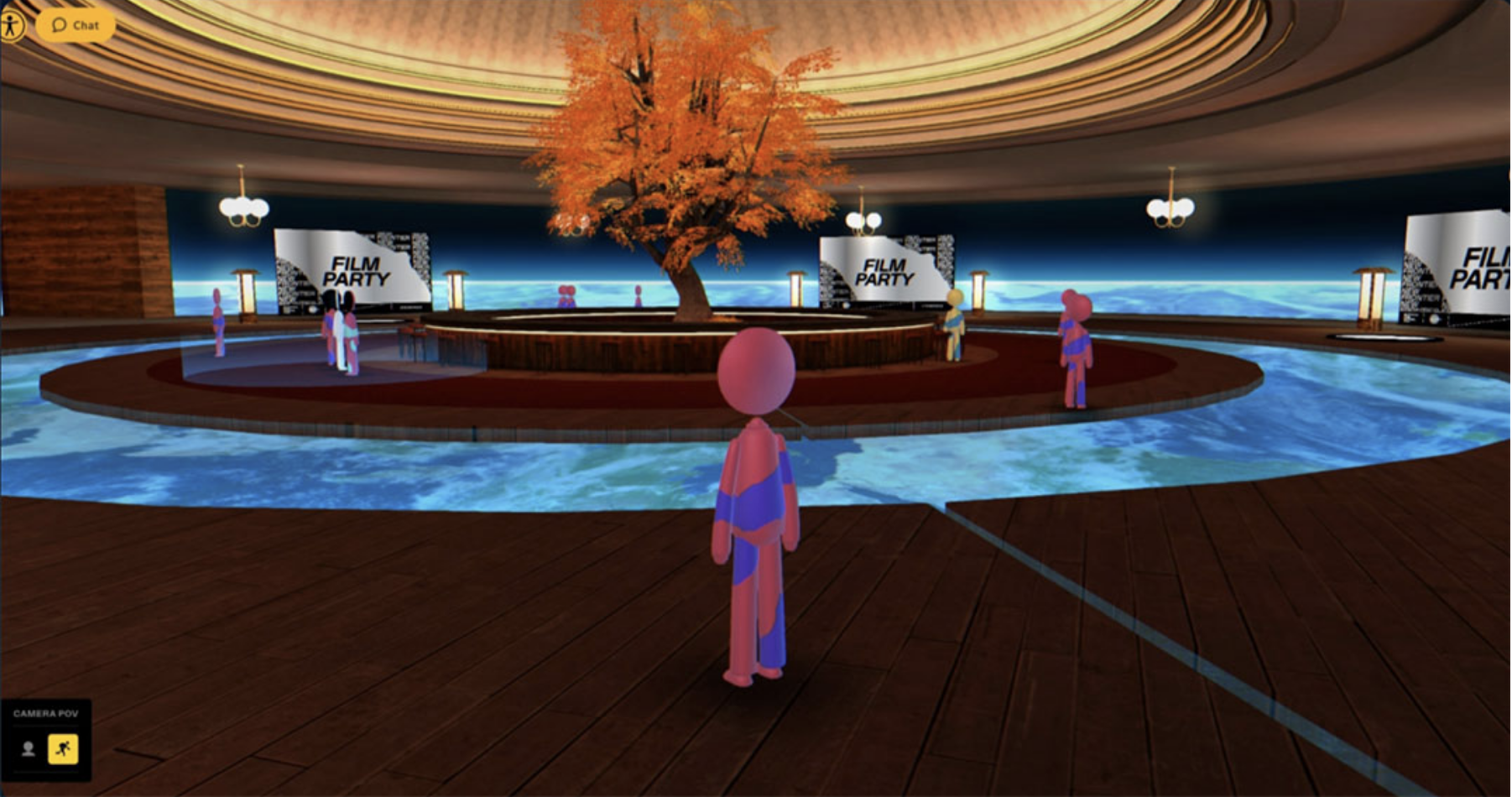
Sundance New Frontier via Dreamwave
A middle is emerging with companies like Spatial who are creating spaces beyond a conference setting for commerce and gathering, like an art gallery setting where you and your avatar can take in the scene. It should also be noted that in some cases, these experiences can be taken in via a VR headset so that you are beamed into these settings for a more immersive view.

From the video perspective, all provide video portals for the broadcast and content can be presented one to many, one to one and small group meetings. In some cases, videos are presented in faux movie theater settings, another attempt at providing context to the experience. This visual layer of Virtual Immersion platforms will likely evolve significantly as we move to hybrid events, with more detail added to truly establish a sense of place (Javits Center vs. Las Vegas Convention Center, etc.) so that virtual attendees don’t experience too much visual dissonance when they arrive at a place.
THE INTERACTIVE LAYER OF VIRTUAL IMMERSION PLATFORMS
Next up for Virtual Immersion Platforms is the interactive layer, arguably the most challenging area for any event platform to provide organic engagement. Nearly every platform offers the basics of networking, break out rooms, live chat, video on demand, etc. Some, like Brella, are upping the engagement game by providing algorithms for matchmaking which provide relevant connections that deepen interactions.
Virbela, a company founded by organization psychologists, has arguably one of the most unique approaches to solving interactivity by creating virtual worlds that include offices, conferences, town hall squares and expo halls. The platform gives users agency by having them create an avatar who then travels through the virtual world and interacts with others who are there. These interactions include the ability to talk 1:1 via spatial audio in either public or private spaces, play games from scavenger hunts to soccer, and participate in meetings or round tables all with the ability to share video content via portals in the virtual world. The real key to interactivity here is that the user has agency and is forced to direct where their avatar goes, rather than focusing on watching others in a Zoom frame. The other interesting piece to this approach is that everyone else who is in this world is a person, not a bot. This provides for an approximation of serendipity and organic-ness that just isn’t possible on video-based platforms.

VirBELA via Ryan Schultz
THE DATA LAYER OF VIRTUAL IMMERSION PLATFORMS
All of this activity, visual and interactive, rolls up to the data layer. Arguably the biggest benefit to virtual events is the ability to understand every aspect of the experience and be able to act on that information either to follow up with an attendee or to make the next event more engaging. This is the space that pre-pandemic was largely in the back seat, and now will likely be the one reasons, beyond scale, that virtual events remain long after the pandemic ends. Afterall, what marketer will not want to maximize their reach and understand what the engagement rate was for their event post-pandemic? A platform that has an advanced data layer is Meeting Play, as evidenced by their ability to, in addition all of the visual and interactive functionalities mentioned above, provide mature personalization tools to help attendees network while filtering session and agenda content. It is this ability to deploy algorithms across a Virtual Immersion Platform that really offers a glimpse of what’s to come. As we think about virtual events being used as a media channel, the data layer will be the key area where marketers will look to understand ROI as compared to the other media channels they are using to reach audiences.
THE ROAD TO HYBRID
Getting back to the Evans quote, it is clear that Virtual Immersion Platforms are expanding what it means to gather both in form and in function. When we think about having had the ability to ‘do the work differently’ now for the past 15 months, it shouldn’t be a surprise that we are at the stage of re-imagining and moving to the ‘change what the work is’ phase. This is particularly evident in the conversations currently being had about hybrid events. This is the space where there will be an intense period of innovation as we start to see multiple audiences gathering across physical and virtual spaces. The ability to bring these audiences together equally will be the key to the evolution of hybrid events. We believe mobile will be an important tool to enable the connection, particularly when, according to Markletic’s February 2021 survey of 3,000 event organizers, “71.1% of event organizers say that connecting the in-person and virtual audience is their biggest challenge.” Mobile will become the key tool to ‘change what the work is’ in the evolution of hybrid events.
Here are thoughts on how hybrid evolves that emerged from conversations I had with Jeremy Patuto CEO of Eventfinity and Brandon Wernli, President of BW Events:
In-person audiences will have an augmented experience and will be able to rely on the crowd in the cloud to fill out their experience via mobile.
Keynotes and sessions may get shorter to allow time for people to interact face to face.
The in-person cohort can act as a tele-present guide through their mobile device to the online cohort either livestreaming what is happening off-camera or isn’t being covered.
To build on the recommendation engines mentioned above, it will make sense to also have the ability to combine online recommendations with physical recommendations for either booths to visit or sessions to attend. Again, when we think about what tool can enable this, it is clear that mobile will be the primary device that can aid in recommendations using location tracking and other technologies to make the in-person experience smart and anticipatory.
Gamification of the entire booth experience will explode and we will start see functionality where a rep can broadcast on the spot from their mobile device to an audience of 1 in person at the booth and to 30 virtually.
Finally, a suggestion on where to look for a view into the future of hybrid events: The CBS TV show Let’s Make a Deal. Seriously, take a few minutes and watch how both the in-person and remote audiences are treated equally and get to participate together. I was initially skeptical when Patuto made this recommendation, but I immediately saw the analogue. Both audiences are extremely passionate about participating and engaging around the shared experience, and that should be the beginning of how to think about designing hybrid experiences.

Let’s Make a Deal via CBS
TOP FIVE TAKEAWAYS FROM THE 2021 CES DIGITAL VENUE
I wrote this post in the middle of AJ’s Virtual Platform content series. While most reviews of CES are focused on the new gadgets, technologies and announcements, I wanted to focus on the digital experience the event put on as it was fully virtual.

My top five takeaways from the 2021 CES Digital Venue are:
Create a simple to use Digital Venue interface that doesn’t overwhelm with complications
Take a cue from Verizon, brands should provide immersive, multi-device keynote show experiences with interactive content to captivate their audience
Digital Venues should allow for user discovery but also provide hints and prompts to help the journey.
Exhibitors should provide immersive companion micro-sites to let visitors go deep on their products and story.
As a rule, any digital venue should provide a recommendation engine to fuel discovery of exhibitors based on registration data.
As someone who has attended the Consumer Electronics Show (CES) for the past 7 years, I was a bit disappointed by not being in Las Vegas last week. There is simply no other live event that provides the depth and breadth of what’s next in technology, trends and networking on the planet. I was definitely skeptical that the virtual version of CES could measure up to the live experience. From a platform standpoint, I’d have to say kudos to Bob Bejan, CVP Global Events at Microsoft, and team for putting together what looks to be a leading-edge virtual event platform and experience.
This post will not be through the lens of the new technology, gadgets or trends coming out of CES, but will focus on what the virtual event experience was like. Picking up a quote from Bejan in the announcement that Microsoft would be CES’s event technology partner, he said, “…you cannot translate a live event into a digital format. You must remake the event entirely.” I’d have to say I totally agree.
The CES Digital Venue reportedly used ‘Microsoft Cloud solutions, including Microsoft Azure, Microsoft Teams and the Microsoft Power Platform, together with partner solutions’ to provide the overall experience.

As a starting point, let’s take a look at Hans Vestberg’s keynote on 5G, he’s Verizon’s Chairman and CEO. Vestberg and his team definitely leaned into the idea of remaking the keynote virtually. Set on what appeared to be an XR Studio stage, the keynote blended traditional stand-and-deliver content with remote picture-in-picture interviews, on-stage co-hosting with AR flourishes and a full, second-screen mobile experience.
While the show was interspersed with pre-recorded content, the live content was surrounded by a background of crisp 3D imagery and animations that captivated and held my attention throughout. Vestberg was fully visible from head to foot as was his momentary co-host, football & baseball star Deon Sanders. There was a nice moment where AR football players moved fluidly between them.
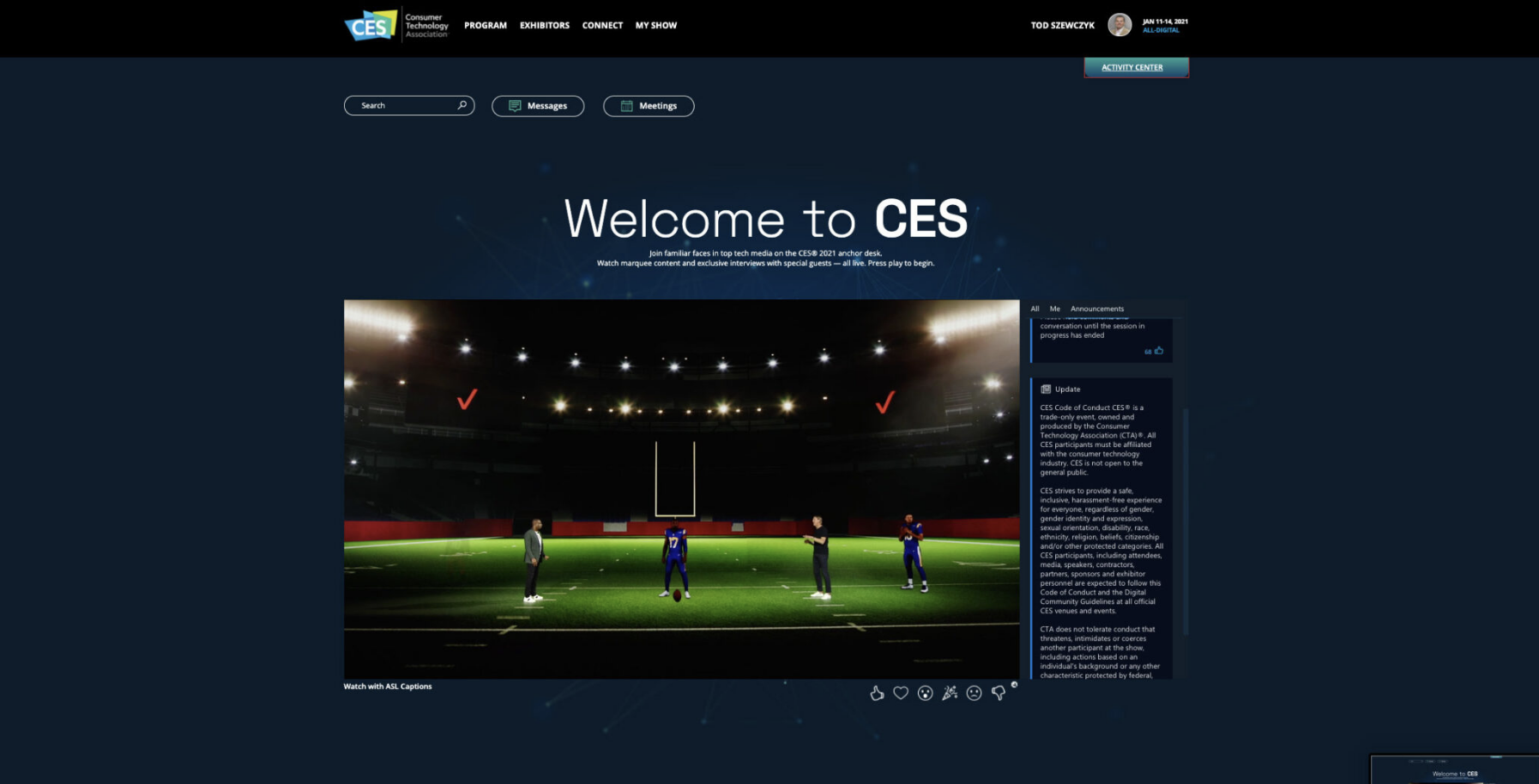
Additionally, just before Vestberg interviewed Lonnie G. Bunch III, Secretary of the Smithsonian, an AR render of the Apollo 11 Command Module floated next to him on stage. This interplay of augmented content with live host in a virtual setting is starting to become a storytelling trend in virtual events and shows the flexibility and creativity of what can be done in XR.

All of this was beamed through the Microsoft platform seamlessly with very little lag time. The video frame allowed me to push the stream to full-frame and, although I could pause the feed, I was brought to live when I un-paused instead of picking back up where I left off.
The event platform itself offered the standard gamification elements from live chat functionality along the right sidebar to emoji buttons along the bottom of the frame. The emoji’s continually flashed throughout the keynote and were somewhat distracting to my eye. Moving down the event page, there were multiple content carousels with recommendations on other keynotes to attend that were relative to the topic I was viewing.
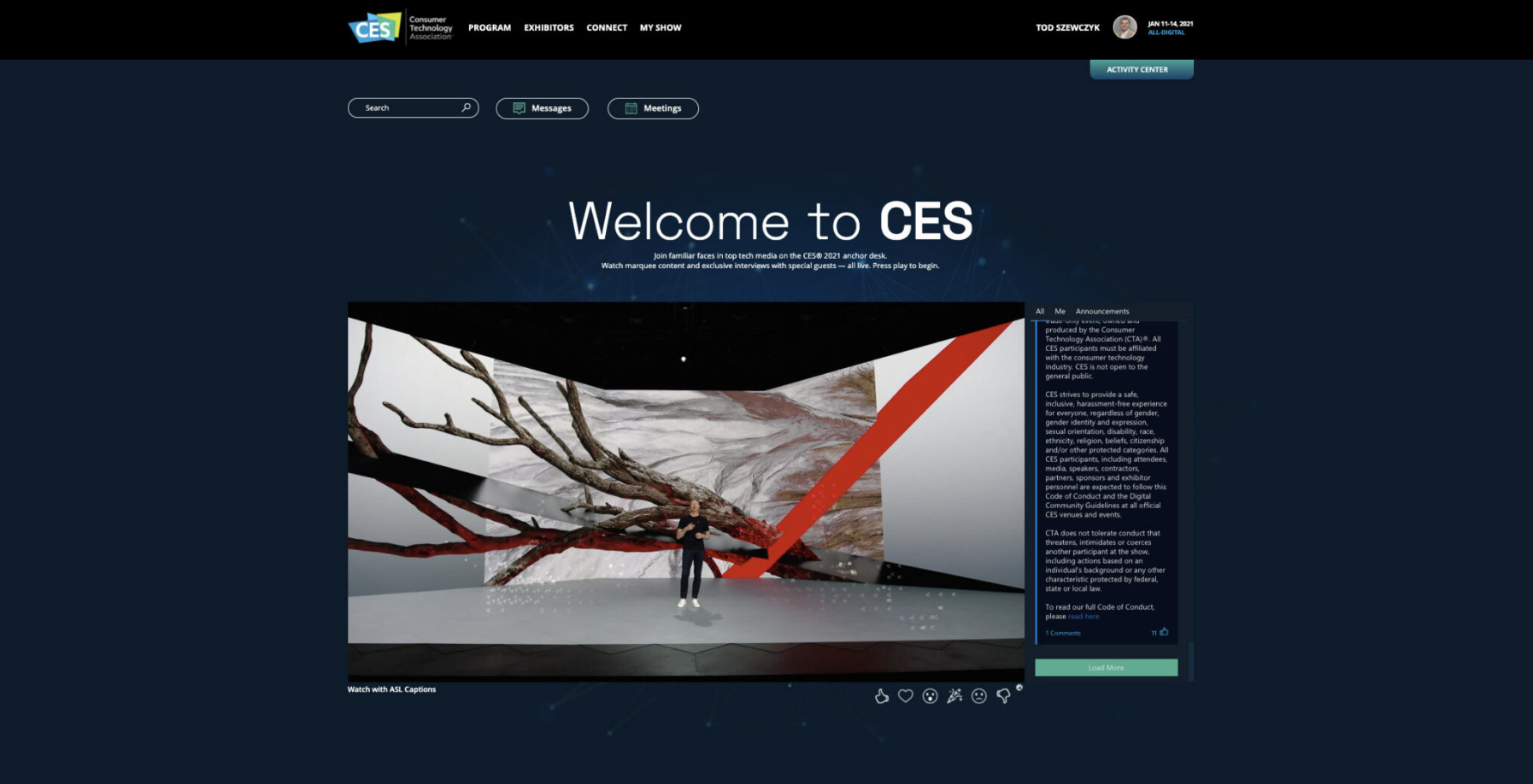
While I had added the Verizon session to my agenda before it went live, I did not receive an email prompt that session I had registered in was starting, this felt like a missed opportunity from an engagement standpoint. One piece of the show that I missed in the beginning was the audience center host experience, that said, providing a virtual home base in the venue for users to start and return is a best practice to create a sense of place.
A quick word on the Black Pumas second screen experience. After the Verizon keynote was over, the Black Pumas played a few songs. While this was fully visible on my laptop, I could also scan a QR Code with my phone to go on stage and watch from that close up view. After I scanned the code, I waited for a few minutes for the content to load. Once it did, I could control the camera angle and watch up close as if I was on stage. There was a bit of a lag between the stream on my phone and laptop, my phone was not on 5G and my laptop was picking up the signal through wifi. Lag notwithstanding, I found the content to be engaging and stuck around until the end.

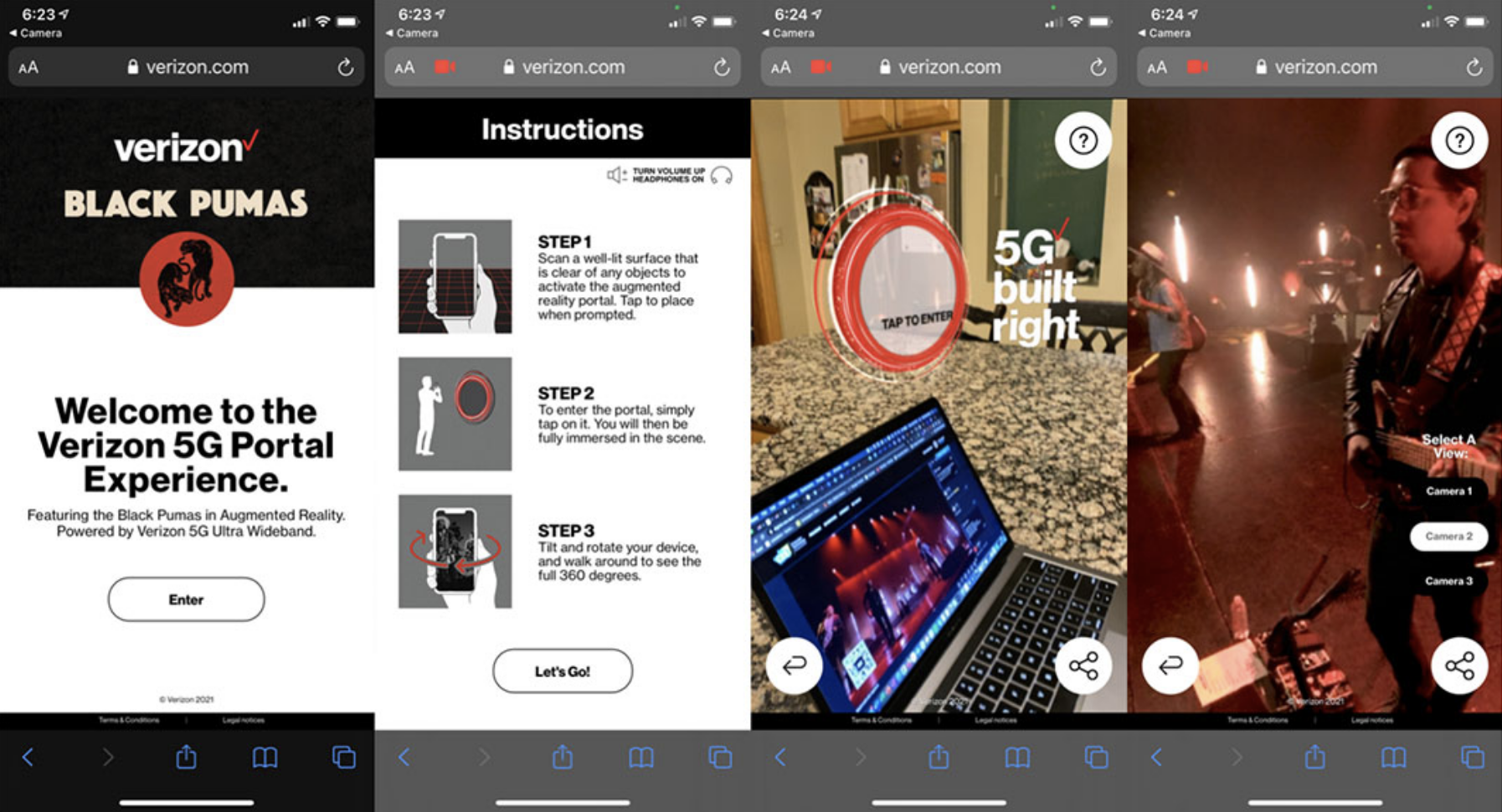
All told, I remain impressed with the Digital Venue’s functionality and appreciated all of the effort the Verizon team put forward in producing a highly immersive and engaging keynote.
Another notable session at the event was iHeartMedia’s Reimagining Entertainment presentation with Ryan Seacrest and Dua Lipa, along with a performance by Billie Eilish that was hosted in Spatial Web’s platform. CNET covered what the Spatial Web experience was like, attendees were able to teleport to virtual rooms, surrounded by spatial audio and also had the ability to walk up and start a conversation with other groups of people. These types of serendipity platforms are nascent and will continue to grow throughout the year as a way to recreate the live concert experience.

Moving over to one the key aspects of CES, the Exhibitors, or ‘Show Floor”, I found the entire experience to be underwhelming. In previous years attending CES, I’ve spent weeks planning out what booths to visit and setting meeting times. With the move to virtual, I was hoping/expecting that Microsoft would employ some type of recommendation engine based on the data I provided at registration. This did not appear to be the case. Whenever I went to the Exhibitor area, I was offered a blank search box with a number of tiles below to companies that had no relation to the information I entered at registration. Perhaps this was some type of sponsorship strategy? While I understand the need to monetize, there simply has to be a better way to give users a personalized experience and a way to discover new companies.
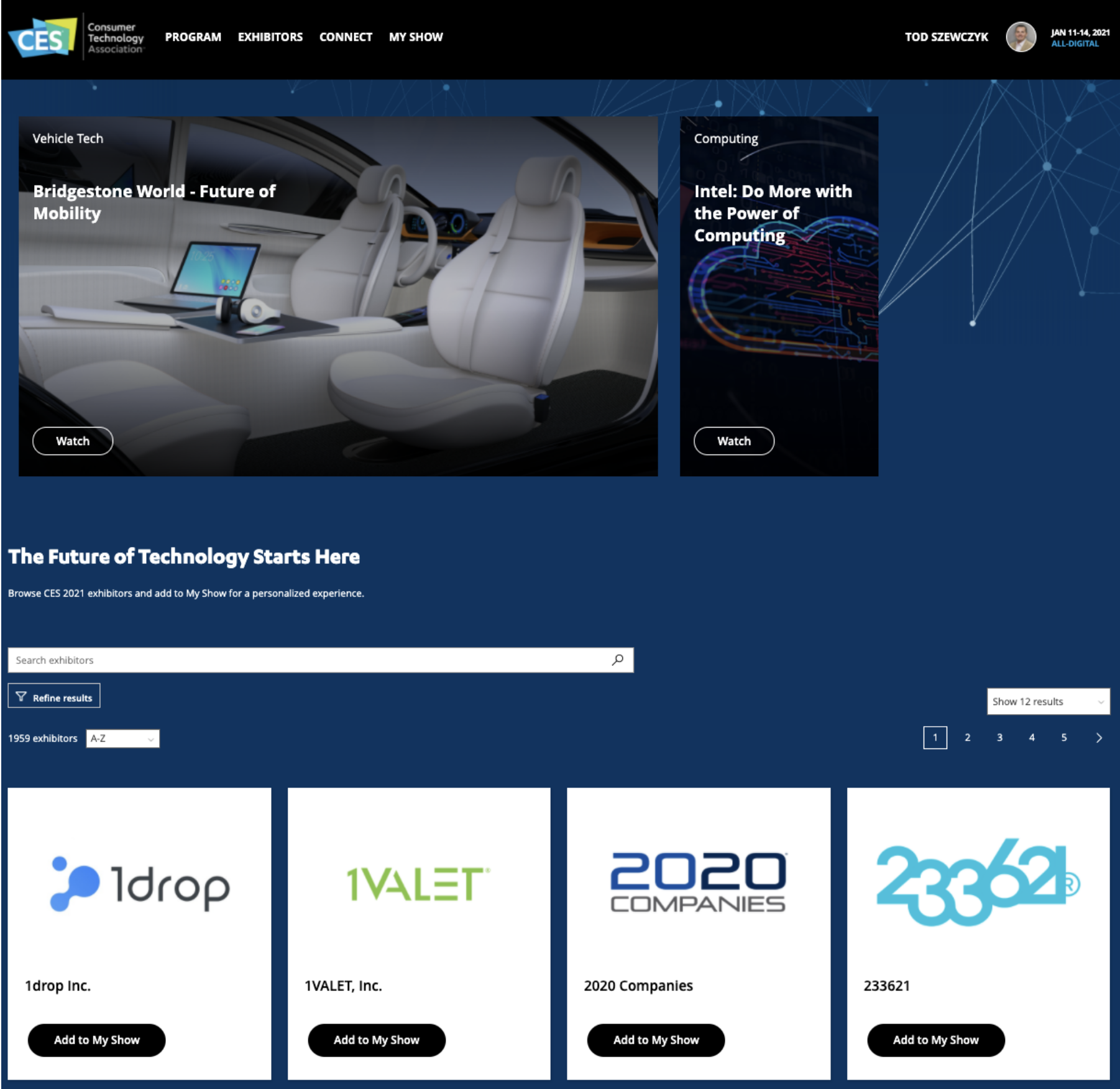
Moving on to the company booth experience, clearly, there is no way to re-create the physical booth experience in a virtual setting. I was able to make connections with a couple of companies and used the live chat function in a few of the booths. Intel’s booth has always been a highlight of the show, their display of the latest tech and the experiences it can create is beyond compare. This year, their virtual booth offers a ton of content from presentations to sessions to a way to connect. All well laid out and visually appealing.

There is also a companion micro-site that pushes you out of the CES experience found within their booth. This is where things got interesting and made me feel like I was at CES. On the microsite, they offer a chance to visit “The City of Doers” which is an immersive experience that walks you through how their technology is evolving the way we ‘work, play and move through the world’. This experience allows me to click into different areas of a city block and see Intel’s technology in action. Presumably built in WebGl, the interface is smooth and provides an in-depth experience that the CES site itself does not. More and more, these types of immersive micro-sites will be the part of a virtual event that captures visitor’s attention and provides them with that surprise and delight experience that live offers.


In general, I thought Microsoft’s virtual platform worked really well, and the fact that I have another 30 days to go through all of the content is definitely a big bonus. Although it wasn’t the full Vegas experience, and there are clearly areas that need to improve, this is a good glimpse of what virtual/hybrid events will become this year. The immersive micro-site linked to the company booth is a trend that will only grow, and it will be interesting to see if any event platform starts to offer this functionality. Going back to Bob Bejan’s quote, there is no way to recreate what a live event is digitally, but there is a way to make the virtual event experience compelling. I think this year’s CES showed what that looks like and also how powerful virtual events can be.
A FIELD GUIDE TO VIRTUAL EVENT PLATFORMS: CHAPTER 2 – VIRTUAL EXPERIENCE PLATFORMS
This post is part of a content series I wrote in 2020 & 2021 at August Jackson looking at the virtual event platform space. Chapter 2 dives into virtual experience platforms and how to battle zoom fatigue.
In Chapter Two of the Field Guide to Virtual Event Platforms, we start with a quote from J. Damany Daniel, Chief Imaginator at The EventNerd. Speaking at Socio’s EventHack Hybrid Games in November 2020, Daniel said, “Zoom fatigue is a real thing. We are on Zoom calls all day, every day. Zoom fatigue is a diagnosed conditioned. But you know what is not a diagnosed condition. ESPN fatigue or Netflix fatigue… You know why? They tell better stories.” It’s a prescient quote that sets the stage for this post on Virtual Experience Platforms in the B2B event space.
As we noted in Chapter One, we are defining a Virtual Experience Platform as video-based hub delivered in a website format with a Zoom-like streaming experience (live, simulive, pre-recorded), breakouts, chat, tradeshow booths, and networking centers.
Looking out across the B2B event landscape, this definition will evolve as what we are able to produce evolves due to the pandemic normalizing remote work. Even with the hope of vaccines on the horizon (I’m writing this post on December 8, 2020, the day the first person in the U.K. received the Pfizer BioNtech vaccine), most of the events we are planning for 2021 are virtual, with the hope that, best case scenario, they go hybrid if happening in Q3-Q4 2021.
Reflecting on Daniel’s quote, we here at AJ think that breaking out of the Zoom fatigue syndrome and creating impactful and engaging events comes down to three things: Astonishment, Engagement and Personalization. By putting purpose at the center of what we create, and anchoring ourselves in the shoes of the audience, we start from a place where we can build dynamic experiences that engage and propel them to action. The selection of the Virtual Experience Platform plays a key role in enabling this. That said, the platforms are not all created equal and tend to excel in one or two areas across the cycle of pre-event, event and post-event.
In the pre-event stage, companies that excelled at in-person event registration like Cvent have evolved into a top player in the virtual world. Companies like Meeting Play and Brella have introduced algorithms to help registrants personalize their event through networking and content suggestions. Finally, Attendease offers super-flexible registration capabilities that provide a well-designed and easy-to-use interface. This is where the analog back to Netflix comes into play; bundling a recommendation engine into a compelling interface reduces the friction of finding relevant connections and content, we believe this will be the key to making the B2B event space more reflective of modern consumer experiences.
In the day-of event stage, creating a state of astonishment in the audience through amazing and relevant content and experience is critical to keep them engaged. As I mentioned above, starting from a place of empathy for the audience and applying classic storytelling and theatrical elements can organically draw them into the event. This is where it is important to consider platforms that can provide a perfect video feed with all of the broadcast embellishments (intros, outros, transitions, lower thirds, bumpers, interstitials, etc.) will draw in the audience and help them see the story. Adding gamification elements to compel authentic engagement and build the community, helps keep their attention. This is where we see platforms like BigMarker, Bizaboo and BrightCove as great options to bring together the broadcast experience with a natural and delightful form of engagement through clean interfaces and mobile apps.
Finally, in the post-event stage, understanding where engagement worked and learning from areas where it didn’t is critical to prove out the success of the content and areas where it can be better. While surveys were a tried-and-true way to gauge audience satisfaction pre-virtual, new tools and techniques are available to precisely measure and understand the audience journey. Platforms that stand out in this stage provide the ability to apply machine learning to help read and interpret audience signals along with the ability to integrate into sales automation tools to close the loop. Companies like RainFocus provide the ability to track the audience journey from the very click to the last-second they leave the platform and can package this information in highly configurable dashboards that allow for transparent reporting.
Another area to consider post event is that the content can live infinitely in the digital universe and reach audiences that were not able to attend when the event was live. Socio shines here, the event that I mentioned at the top of the post is a good example of being able to go back and attend after the fact. The combination of analytics and content longevity will arguably the area where we need focused innovation as events transform from virtual to hybrid.
As we move into 2021, we believe we will start to see platforms offering premier functionality across the entire cycle of an event, due to the amount of capital that is flowing into the market (see Zoom, Hopin & Bizaboo). Indeed, the very notion of what an event is will evolve as these new experience platforms grow in form and functionality. Going back to the beginning, the only way to battle virtual event fatigue is through extraordinary, relevant content delivered through a seamless and intuitive interface. In The Hybrid Era, we expect that this market will mature so that buyers in the B2B event space have solid, singular options that effortlessly address all event phases.
A FIELD GUIDE TO VIRTUAL EVENT PLATFORMS: CHAPTER 1 – THE OVERVIEW
This post is part of a content series I wrote in 2020 & 2021 at August Jackson looking at the virtual event platform space. Chapter 1 dives into the different types of platforms and the new marketing opportunities the platforms enable.
The new and evolving world of B2B communications during COVID-19 is reminiscent of some of the shifts in communication and technology I have witnessed in my 20-year career in the B2C advertising space. Advancements such as Search, Web 2.0, eCommerce, Mobile, Social, Immersive, Omnichannel, Data-Driven Content, Machine Learning, Artificial Intelligence, and Voice have all come to play integral roles in the way businesses function.
The distinguishing difference from the previous shifts to what we are experiencing today is speed. Each of the above evolutions began slowly and took years to rise to prominence; the shift underway from in-person to virtual events occurred in a matter of weeks. No doubt, the pandemic was the driving force, and had it not occurred, Zoom’s market capitalization would still be at its January 2020 level of $17 billion, not the $114 billion that it is now hovering at as of November 2020. With that said, as someone who has spent the past decade working in the emerging technology, digital strategy, and innovation space, it is hard not to get excited for what the fundamentals of this shift represent: new forms of communication, new ways of working, and new opportunities for businesses to engage with their communities.
Through this lens of accelerated change, we’re establishing a regular bi-weekly content series called ‘A Field Guide to Virtual Event Platforms’ to examine how virtual event platforms are evolving and what it means for our clients. While the past six months have brought on unprecedented change, it’s the next six to twelve months that we will be focusing on as we see the possibility of change on the horizon.
As a company, we have produced over 40 virtual events since March. In August, we assembled a team to evaluate 105 software companies and identified three different types of virtual platforms: Virtual Experience Platforms, Virtual Immersion Platforms, and Custom Platforms.
We define these as:
Virtual Experience Platforms: video-based hubs delivered in a website format with a Zoom-like streaming experience (live, simulive, pre-recorded), breakouts, chat, tradeshow booths, and networking centers
Virtual Immersion Platforms: experiences that attempt to recreate the live conference setting with a simulated lobby, keynote theater (for live, simulive, and pre-recorded content), tradeshow booths, and networking centers
Custom Platforms: Bespoke experiences built to meet a client’s specific event need
We take a platform-agnostic approach when working with our clients because we believe the purpose of the event and the outcomes we are trying to achieve should drive the platform we use. This provides us with a competitive view of where the market is going that puts us in a position to buy the latest innovations. Our experience navigating this new mode of gathering has shown that the most important area to focus on isn’t necessarily the technology, but what behaviors and outcomes we are fostering. With this mindset, we look to use purpose-driven creativity and design to inspire our audiences during the event. Post-event, we look for ways to keep bringing the purpose of the event back to the audience, creating a state of sustained engagement over time.
Our clients often ask us how we evaluate a platform — to that end, we’ve developed a series of questions to understand what their goals are, which leads us to the type of platform we would recommend. Once the type of platform is identified, we then go through the process of demo’ing the leading platforms and companies in that vertical. At a high level, when we evaluate platforms, we start by asking the following questions:
WHAT ARE THE CLIENT’S GOALS FOR THE EVENT?
What content does the client need to share?
What are the overall goals of engagement?
Who is the audience (including number of attendees) and what is the desired user experience?
What KPI’s are important for the client?
What type of reporting will be valuable for the client?
Are there current tools the client’s IT team wants to use to support the event?
What is the longevity of the experience?
WHAT IS THE SCOPE & BUDGET?
What is the investment appetite?
Is this a single-day or multi-day event?
What is the ROI for the client?
How does the client need to be perceived by audience?
What is the project timeline?
Is there a hybrid component?
WHAT ARE THE MUST-HAVE FEATURES?
Will there be a live show?
Do we need to provide breakout capabilities for the audience?
Will we need a speaker Q&A within the session?
Do attendees need to register?
Will attendees build their own agenda or is it dictated by their registration type?
Do attendees need the ability to network, meet 1:1, or in small groups?
Will there be a virtual vendor/sponsor experience as part of the event?
What is the pre-event, day-of, and post-event messaging strategy?
What sort of interactivity and gamification is desired?
Will there need to be post-event content on demand?
The answers to these questions will point to the type of platform that is needed. From there, we then add a technology-focused set of standard functionality and requirements:
Functionality (hat tip to the Linux Foundation):
Web-based (HTML5) supporting Windows and Mac desktops/browsers (and also Linux)
Registration integrations that will comply with GDPR and privacy regulation requirements
Webhooks or REST APIs to integrate with security systems like SSO (Auth0) and SFDC.
Can be white-labeled for the client’s community’s event branding
Speaker Q&A chat available within sessions
Attendee networking capabilities
Integrated scheduling tools and agenda builder
Attendee analytics: booths visited, session attendance, etc.
Gamification options to drive attendee engagement
Pop-up notifications throughout the platform (‘Keynotes starting in 5 minutes!’, etc.)
Guaranteed uptime, redundancies, and autoscaling
General Questions:
Is the platform optimized for a particular browser/browser version?
What are the design customization capabilities, and can we customize via Javascript & CSS?
Can we pull the platform experience through to a different site via iFrame?
Does the video streaming function accept an RTMP feed?
What cloud service is the platform hosted on?
Does the platform rely on Zoom to power any portion of the event and if so, how is licensing handled and what is the user experience?
How did G2/Gartner/Forrester rate the platform?
What type of day-of support is offered?
This list of questions and considerations should be thought of as a living document, evolving as the market evolves. Given the increase in market capitalization of Zoom, noted above, combined with the recent valuation of Hopin, we believe that for the foreseeable future, product evolution will move at a rapid pace. Competition drives differentiation — what the current virtual event platform landscape looks like now, in November 2020, will likely be drastically different by March of 2021.
When done well, virtual events can provide the same spark and inspiration as live events. The platform is an important component to the overall experience, but it is the creativity, design, and content in combination with the platform that makes the magic happen.
Exciting Update: Today I officially joined the B2B brand engagement agency August Jackson.
Here is a link to the press release, the full announcement is below.

August Jackson Hires Industry Innovator to Lead Digital Engagement Offering
Former Leo Burnett executive Tod Szewczyk brings technology and innovation expertise to enhance agency's virtual-engagement offering
CHICAGO, Ill., Sept 2, 2020 / –Brand engagement agency August Jackson has hired Tod Szewczyk, former VP/Director of Emerging Technology & Digital Strategy at Leo Burnett, to the newly-created role of Executive Vice President (EVP) of Digital Engagement. In this new role, Szewczyk will work to bolster the agency’s digital capabilities and help architect the ways in which communities engage beyond the physical world.
At Leo Burnett, Szewczyk has had a hand in building the first-ever innovation labs that featured new ways of connecting with consumers through technology, curating technology thought-leadership and managing vital partnerships such as Burnett’s partnership with Google. With over 20 years of experience, Szewczyk has enabled digital transformation with measurable outcomes for companies such as Coca-Cola, McDonald’s and General Motors.
“My experience creating meaningful consumer experiences through purposeful technology for some of the world’s best-known brands has prepared me to help August Jackson and its clients find new ways to engage via digital tools”, Szewczyk said. “I’m excited to join this creative team and look forward to helping AJ’s clients achieve their goals and build their business.”
“With Tod’s deep expertise in technology and digitally-enabled engagement, we’re able to better help our clients build deep and lasting relationships with the communities they care most about”, said August Jackson CEO Laura Shuler. “By strengthening our digital capability, we’ll truly be the ambidextrous agency that creates sustained engagement over time through both physical and virtual interactions.”
Tod joined the agency September 1 as a member of its Executive Team, reporting to CEO Shuler.
ABOUT AUGUST JACKSONFor organizations that require highly-engaged people to realize their mission, August Jackson is the brand engagement agency that puts purpose into practice. Our work for corporate brands, hospitals, nonprofit organizations and higher education institutions includes branding, campaign development and multi-channel activation, with an emphasis on live events and technology-enabled engagement. Recognized as a top agency by Chief Marketer and Event Marketer and a Crain's Chicago Best Places to Work award winner, August Jackson works with clients throughout the US and has a presence in Chicago, New York City, Washington, D.C., and Baltimore. https://www.augustjackson.com
Winning the Digital Transformation Networking Challenge Panel
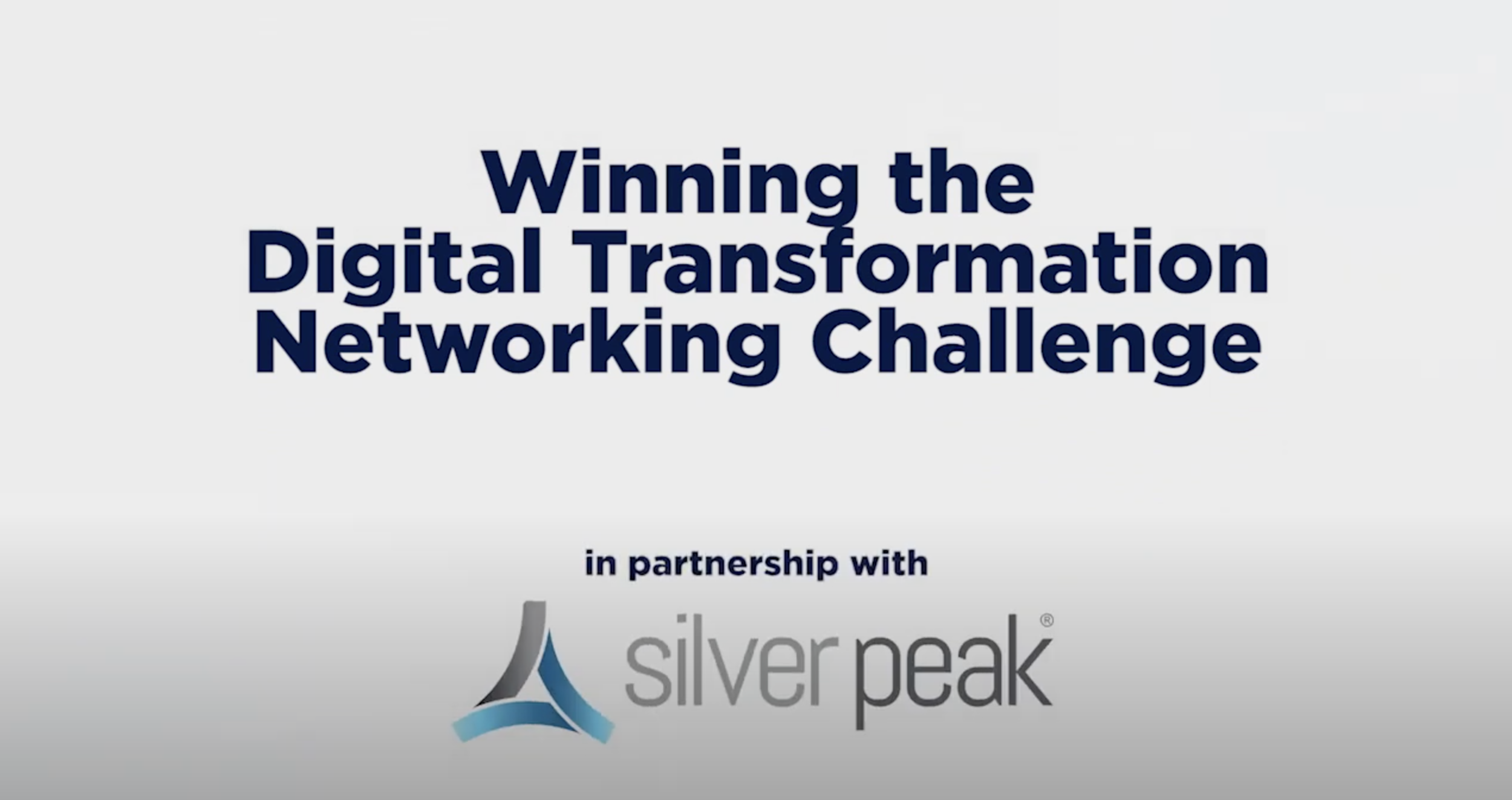
I participated in a virtual panel on the topic of Digital Transformation and Networking sponsored by Business Development Institute and Silver Peak. We talked about the benefits of embracing a business-first networking model to drive digital transformation. I really enjoyed the virtual element to the panel, we had above-average audience participation during the discussion since the traditional stage/audience dynamic wasn’t in place. Link to the full recording can be found here.
Wave Hello to the Future of Marketing

Computer vision image from Second Story Atlanta
Here is an article I wrote that was originally picked up by Campaign Brief. It examines the question, "Will new gesture technologies fundamentally change the way consumers interact with brands?" Special shout out to Kappie Kopp and the MSL team for editing this. Images taken by me at the Second Story lab in Atlanta.
Wave Hello to the Future of Marketing
Isn’t it curious how strongly language and gesture are linked? Together, the two form the foundation for interpersonal communication—such that if you take one from the other, you can lose half the meaning of what’s being said. In his book “The Expression of the Emotions in Man and Animal,” Charles Darwin observes that, “all of the chief expressions exhibited by man are the same throughout the world.” Modern studies have taken our understanding of gesture even further. A 2013 paper in the Annual Review of Psychology asserts that gesture can reflect our unspoken thoughts as much as our articulated ones, while another article in the Journal of Memory and Language connect gesture’s ability to make communication more memorable.
In other words, gestures help our communications be better understood, and better remembered. As marketers, those two takeaways should catch our attention—after all, what brand doesn’t want to be universally understood and remembered?
Not surprisingly, brands are noticing the power of gesture—look no further than your smartphone to see how its role is on the rise. Apple, Google and Samsung all released gesture-enabled flagship phones this year.
A swipe, pinch, wave of the fingers
Samsung’s latest phone, the S10, has taken a pretty significant step in their OneUI interface on the Galaxy S10 device—when a user turns on gesture controls, the three standard Android navigation buttons disappear (yikes!). The only way to control the phone then is to swipe up in certain places. Apple’s newest iPhones and iPads have improved gesture control elements baked into the latest operating system, and the new U1 chip included in the iPhone 11 family is rumored to be ‘a stepping stone to gesture-based controls to better interact with smart devices’, aka smartglasses. Google’s latest phone, the Pixel 4, includes a radar-based sensor called Soli that, according to CNET, is “able to detect 3D movement in space,” allowing users to control the device with simple hand gestures. As Google puts it, “You are the only interface you need.”
These may seem like incremental advances, but since the release of smart devices like the iPhone or the iPad, we are seeing a fundamental change in the way children engage with the world around them. Educators in the UK recently noted that children tend to swipe pages of paper books as they assume that they are screens; you may have seen a toddler do the same. As our phones become gesture-first, consumers will start to learn to apply that interaction to other aspects of their lives.
In the home, on the go and in stores everywhere
Samsung already leads the way on replacing the remote, allowing you to manipulate the TV with your hands through swipe, zoom, like and grab. From Audi to Volvo, nearly every major car manufacturer has a model with a hands-free liftgate, the gesture here is a wave of the foot under the rear bumper.
We are even seeing it in our apparel. Google’s Project Jacquard, which uses conductive threads woven into items to create touch-sensitive areas, can be found in the Levi’s commuter trucker jacket and Yves St. Laurent commuter backpack—allowing you to control your phone during a bike ride or on the commuter train with minimal distraction or interference.
Moving into the brick-and-mortar store, Amazon is currently testing a biometric payment system at its Whole Foods offices in New York that uses a combination of computer vision and depth geometry to recognize a consumer by the wave of their hand and link to their credit card on file to enable speedy checkout.
Next-level ad campaigns and brand interactions
As the conversation around gesture continues to grow, it will also continue to be refined. There’s a higher-order to gesture called Natural User Interface (NUI), which the Interaction Design Foundation defines as “user interfaces that are natural and easy to use… where the interaction is direct and consistent with our ‘natural’ behaviour.”
Why is all of this important? In a not-too-distant world our phones will start to be replaced by products like AR-enabled glasses, which means the way we interface with the world will likely be by gestures that do not include tapping a screen—rather, simply manipulating the air. Most notable in the pursuit, Apple and Facebook are racing to release smart glasses within the next three to four years. Amazon’s Echo Frames are available now and have Alexa embedded in them, the first step in moving interaction off of the phone and into the air. And surely in this world of controlling our devices without touching them, brands will need to consider if there is a reason for their consumers to employ gesture when they interact. At some point in the next few years, 5G will be a reality and the response time consumers will have to any connected object will be immediate.
So, finally, we ask, “What does this mean for brands?
This isn’t an exhaustive list of every device that can currently or will in the future be controlled by NUI, but it’s enough evidence to demonstrate that our future interface with devices will be through the invisible layer. Just imagine, for instance, that you could summon the Nike Run Club’s app by making a swoosh gesture in the air, then use your fingers or voice to say what distance you would like to run and at what pace and then go. How about McDonald’s, which has been investing heavily in new technologies like voice to improve the consumer experience. Could it be that in a gesture-first world a consumer could signal the Golden Arches in the air, proceeding to place an order by either speaking or swiping through the menu that appears in the consumers field of view? Or what if you could hail an Uber by making a U, then use your finger to confirm your location on a virtual map floating in front of you and watch as the driver makes way to your destination?
The implications of these new interaction points are significant for brands and marketers, providing new opportunities to more naturally reach consumers and create unique bonds with them that will be hard to break. Gesture represents an unprecedented user-centric channel for brands to own, and in bringing gesture to the forefront of consumer interaction, presents a once-in-a-generation opportunity for brands to define or own a new interface. And what brand manager doesn’t have that on their roadmap?
It’s a reality that all brands must prepare for. From ordering a burger to hailing a ride, we are entering the gesture-first world.
Marketing in the Invisible Layer
Here is an article I wrote for Marketing Tech Outlook covering the rise of on-device automation and how it leads to creating ‘anticipated memories’.
Marketing in the Invisible Layer
Welcome to the invisible future. Here, we are perpetually surrounded by connected devices, from the 77% of us who own a smartphone to the 90% of us who own an IoT device. This boom in connected ownership has slowly created an invisible marketing layer, resulting in a purchasable halo around every object and moment.
To put this in perspective, it’s been noted that 90% of the worlds’ data was generated in the past two years. The resulting data layer represents a transformative moment in the ongoing battle for brands to reach consumers; it’s an immense, yet highly complex, opportunity for marketers. Winning in this space means creating value for consumers in the moment before they realize that moment is there.
Daniel Kahneman, the Nobel Prize winning behavioral economist said in his 2010 Ted talk, The Riddle of Experience vs. Memory: “When we think of the future, we don’t think of a future normally as experiences, we think of the future as anticipated memories.” This view is important to keep in mind as we look to see how our devices are evolving and how brands may use these tools to reach consumers in this new space. Our focus will be on mobile given the above ownership rate and that fact that consumers spend on average three hours and thirty-five minutes a day on smartphones.
The latest version of Android Pie includes a key to this new future of anticipation in the App Actions and App Slices frameworks. These two tools were created to help users ‘get to their next task more quickly’ and developers to get those users to re-engage with their apps.
Essentially, the Android OS is moving from predicting the next app a user wants to open to predicting the next action that they want to take. By combining Actions and Slices, the user can get direct access to either booking a car or buying movie tickets with very little input through the search bar. In the same vein of helping users ‘get to their next task more quickly’, Google’s Assistant also offers Routines, a way to create a program of multiple tasks initiated by a phrase like ‘Good Morning’. In all instances we see how predictive anticipation is enabled through technology, specifically in the Google-verse, by on-device machine learning.
And for Apple fans, iOS12’s new Shortcuts and Suggestions feature enables Siri to perform similar functions as Android App Actions and Slices along with Google Assistant Routines. Users will be able to create their own Shortcuts for activities like calling up a train schedule at the same time of the day or logging a workout when complete to their favorite app. Shortcuts are powered by the User Activity API and the new Intents API. It’s the latter that tells the Siri system how you use an app so that it can make relevant suggestions to you based on patterns.
Developers will be able to create the same types of near direct intent access over multiple instances of button pushing in iOS as in Android. Technology analyst Rene Ritchie calls these new iOS capabilities a sign that we’ve moved from the Pull Interface (lots of selecting, button pushing and hunting to get where you want to go) to the Push Interface (where what you want comes to find you only when you need it).
But how long will it take for these experiences to be mainstream? iOS users will likely be the first to experience these new tools, VentureBeat reported last month that it took 11 months for iOS 11 to be installed across 85% of eligible devices. Projecting that rate of adoption out for iOS 12 and most people who have phones that can run the new OS will install it by end of summer next year.
Android is a different animal altogether. While Pie was released in August, it was only available on Pixel. Given the fragmented Android ecosystem, it may take more than a year for it to see any meaningful adoption rate.
So, it’s fair to say that anywhere between one to two years is the lead time on mass audiences seeing this functionality on their devices. While that may seem like a long way off, marketing plans for 2019 are likely locked in and plans for 2020 will probably start to be solidified over the next six months.
For brands, the question is two-fold. First, how do I update my apps to be as predictive as this and second, how do I make my other consumer touchpoints as anticipatory as this? Both questions require some serious consideration around purpose, as in why would a consumer expect a brand to provide this type of predictive service in the first place? Would it seem natural or will it come to be expected that a laundry detergent brand can read my calendar, see that I am hosting a dinner party and then ask me the next morning if I need help removing that wine stain from the table cloth? Maybe, if it knew that the morning after the last dinner party that the same people attended resulted in a ton of searches, posts or texts around wine stain removal. It goes without saying that the consumer would need to opt-in to allowing access to all of the different inputs to make this kind of recommendation. If consumers value the utility in having this type of service, the data exchange might be worth it.
As these new tools are baked into more consumer experiences, we know that they simply may come to expect this level of predictive convenience from brands and platforms. Building for this future now could cement the bond between brand and consumer, and, in Kahneman’s words, create ‘anticipated memories’ through the new invisible marketing layer.
THE ART OF CONNECTING TECHNOLOGY BACK TO PEOPLE
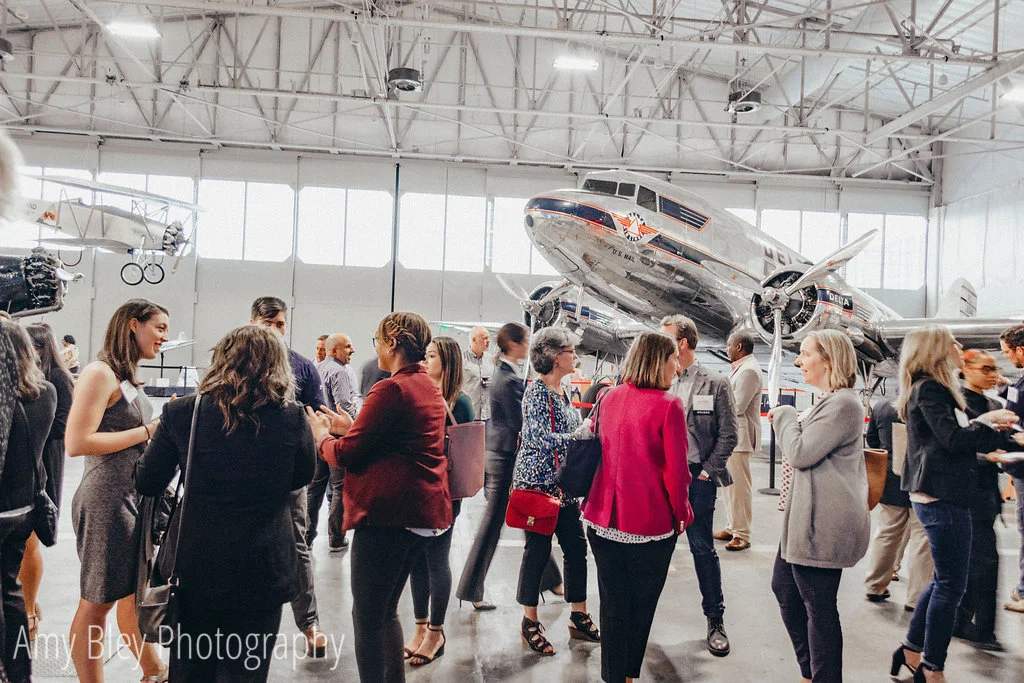
I recently participated in a panel in Atlanta sponsored by the AMA called “Ready for Takeoff: Navigating Today’s Emerging Martech Solutions” at the amazing Delta Flight museum. Images above and below by Amy Bly Photography.

From HotHouse: Augmented Reality (AR), Virtual Reality (VR), Artificial Intelligence (AI), Internet of Things (IoT)…the acronyms are endless, and we marketers are experiencing tech overload. As sponsors of Atlanta’s American Marketing Association (AMA) Innovation Marketing group, Hothouse curated an event designed to provide local marketers with the insights needed to develop effective campaigns that utilize the Martech solutions that are an increasingly necessary part of our world.
Gathering at the Delta Flight Museum, we brought together a panel of top Martech experts to discuss how they’ve been able to implement these solutions within their own companies, and how marketers can make sure their clients and brands aren’t missing the mark.
Moderator, Nicole Jones, Global Innovation Leader at Delta Air Lines, kicked off the night by asking the panelists how they think marketing technology is impacting the traditional way of thinking within the industry. Everyone agreed that Martech is forcing us to embrace change and uncover new innovative solutions. The panelist also revealed a common theme that helped set the stage for the rest of the night’s discussion: The needs of our audience should influence the Martech solutions we pursue.
When asked how marketers can get ahead of the ever-changing trends and topics within the Martech space, panelist Joanie Twersky, Senior Product Marketing Manager, 5G Innovation—Mobility & Entertainment at AT&T, believes that the key to staying on top of the changing technologies is to identify experts in the field that are capable of translating their tech talk.
As marketers, it’s our job to ensure that our communications are displayed in a way that allows our audiences to understand and connect back to it. If the technologies are too complex for our audiences to grasp, the power of the solution becomes irrelevant. One of Joanie’s key takeaways was to ensure that it’s the audience that’s at the center of the solution, rather than the technology. By putting ourselves in the shoes of our audience, and experiencing the Martech first hand, we will have a better understanding of what types of Martech solutions our consumers want and need.
Panelist Jason Brett, Offering Management Director for IBM Watson Marketing’s Personalized Marketing SaaS portfolio, followed up on Joanie’s theme by saying that it’s necessary to find the relevant thread that connects the technology to our consumer, and that it’s our job to understand the impact that the technology is having on them. While solutions like AI are innovative and captivating, we still need the human touch to ensure that it’s having a positive impact on those that are interacting with it. According to Jason, it all comes back to understanding the history of your audience and understanding how they traditionally interact with certain types of technology.
“If you’re not experimenting, you will be left behind,” Panelist Tod Szewczyk, VP, Director of Emerging Technology and Innovation at Leo Burnett, Chicago. Tod stressed that as, innovative marketers, it’s our jobs to take risks that will help develop the technologies that our consumers want and need. By studying our audiences, and learning more about their actual needs, we’re able to be better informed on what types of Martech solutions will resonate with them. We’ll also learn more about what types of solutions they need and want that don’t yet exist. By reminding us that prototypes become a piece of the final solution, Tod encouraged all marketers in the room to think about Martech as not just a trending buzzword, but an innovative solution that will change the way audiences interact with today’s brands and companies.
Active & Intelligent Packaging Summit Americas Keynote June 2018
Below is a article from BeverageDaily that summarizes my keynote from the AIPIA Summit in Jersey City, NJ on June 4, 2018. The question I wanted to explore for this audience was 'can packaging equal an entertainment opportunity for brands to help them reach their audience'? Given the near ubiquity of smartphones, increasing connectivity, unlimited choice and unbreakable routines, how can brands cut through and connect with their consumers?
AIPIA Summit: ‘Brands need to think like entertainment companies’
05-Jun-2018 By Jenny Eagle
People are getting used to having their phone and using it to interpret information around them, according to Leo Burnett.
Speaking at the opening day of the AIPIA (Active & Intelligent Packaging Industry Association) in New Jersey (June 4), Tod Szewczyk, VP, Director, Emerging Technology and Innovation, Leo Burnett, US, said the mobile phone is an interpreter, giving consumers an appetite for 'going deeper' on topics that matter to them.
Hold people's attention
He said brands need to think and act like entertainment companies, this means understanding what consumers want and being able to provide it to them whenever they want it.
"Brands need to become their own entertainment company or partner with one in this space," he said.
In his opening presentation 'How the (new) attention economy creates demand for connected packaging', Szewczyk said packaging will ultimately be looked at as a bridge to entertainment and a bridge to get you offline to online.
"Most of us have cell phones, transforming to a digital connection point, which puts the user at the center of the brand. The challenge is figuring out ways to capture and hold people's attention because they see over 5,000 ads a day.
There are more ads exposed to us than ever before and we cannot possibly process all of that information but it is ever present in our lives. More people are glued to their devices than ever before."
According to Pew Research Center, 77% of US adults now own a smartphone.
"If you're thinking about targeting millennials you are going to have to reach them via a smartphone nowadays otherwise you won't reach them at all," he added.
There are 450 million WiFi networks in the world, up from 100 million five years' ago. 5G will increase download speed to 10GB (gigabytes) per second. Right now, 4G LTE download speed is 1GB per second.
Netflix & YouTube
"We are going to compete with the likes of Netflix and YouTube, social media; Facebook, Twitter, Instagram. As things get faster we ultimately will live in a constantly connected world.
Szewczyk said Leo Burnett works with Google, to build briefs to develop projects that 'speak to people'.
"People's viewing habits have changed. You can't expect people to watch an advert on YouTube because people tune out and if they are not interested they won't watch it," he said.
"People choose what they want to watch and when they like it the 'go deep', ie when you like a TV series you watch the entire series all weekend, or you watch a YouTube video and if you like it you follow the channel online.
"This applies to packaging as well because if we don't create easy ways for people to connect they won't follow you. Our job is to provide the right channels to develop the brand."
Szewczyk added give people a reason to engage with a pack and tell them how to do it. Ask yourself: 'How do I get someone to take their phone out and interact with my brand?'
19 Crimes wine
A good example he said was 19 Crimes wine where each bottle tells a story from a prisoner via a smartphone.

"It's a simple idea from Treasury Wine Estates focusing on the 18-34 year old male category. They took their cues from the craft beer industry experimenting with Augmented Reality packaging," he said.
"In launching this brand it targeted a consumer who has an interest in adventure, when in the 1800s England shipped prisoners to Australia. They story-telling part happens when the label comes to life telling the story about how the prisoner got arrested and their sentence.
"Other examples include Hyper-Reality, a film about what the future will look like in terms of consumerism, which got over 1 million views, Amazon smile codes, Apple is currently making some upgrades to use NFC (Near Field Communication), and Snapchat Lens that responds to sound.
"Influencing new trends will only work if you start by putting the consumer first."
2018 Housewares Show: Leveraging Emerging Retail Technology to Build Brands.
In March 2018, I had the opportunity to talk about how technology is changing the retail experience at the Housewares show at McCormick Place with my colleague Jeff Mau of Digitas. Our talk is below along with a few images from the event. Definitely plan on returning next year.


Nespresso VR(ish) experience. The table sculpture was amazingly detailed, but I was underwhelmed when the content was not mapping to it. Felt like a missed opportunity to create a wow experience. The coffee, as usual, was great.

The world's largest mixer. You can see the wall of mixers in the background.

The wall of mixers with every conceivable attachment on the bottom row.

My future wine cooler...
Future of People, Technology and Advertising @ Print 17.
I recently had the honor of being asked to participate in the inaugural Distinguished Leader Speaker Series at Print 17 here in Chicago. PRINT 17 is the largest gathering of the printing and publishing communities in the Americas. My talk was an updated version of the talk I gave at Connect 17 earlier this year in Denver looking at the Future of People, Technology and Advertising. Printing Impressions ran a review of the talk which appears below.
Leo Burnett's Szewczyk Offers Advice Coping with Technological Change.

Picture this: You’re sitting in your kitchen with your spouse, reminiscing about a trip to Italy. Internet-enabled sensors around you are listening to your conversation, automatically and predictively making reservations and other arrangements.
In the future, we may not even need to type; we will send messages back and forth using brainwaves. “We won’t need technology because we will be technology,” said VP, Director of Emerging Technology & Innovation, at the inaugural Distinguished Leader Session, “The Future of People, Technology, and Advertising,” held Monday morning.
Szewczyk looked at how much people, technology, and communication have changed in the 10 years since the iPhone was launched in 2007, and then looked ahead at coming changes in connectivity (“Li-Fi” is visible light-based networking that is 100 times faster than Wi-Fi), advances in artificial intelligence that may allow phones to understand what they are looking at, the growing predictive nature of commerce, and the next generation of the Internet of Things.
What is the role of print in this future? “Print becomes relevant by being a bridge between offline and online,” said Szewczyk. Think augmented reality (AR). He cited the recent partnership between Google Home and Condé Nast and the voice-activated printed links in the September issue of Vogue, where readers can “talk to the magazine.”
How to prepare for technological change? A strategy that Leo Burnett uses is “scenario planning,” or “exploring and engaging with an uncertain future,” said Szewczyk. “What if everything is listening to me?” “Horizon scanning” is always keeping an eye on what is out there and always experimenting. “If you’re a brand, allocate 10% of your budget to test how consumers respond to different types of technology,” he advised. Advice we should all heed.
Connect 17-The Future of Customer Intelligence.
I recently had the opportunity to speak at Full Contact's first ever conference called Connect 17 in Denver, Colorado May 11/12.
The conference explored the future, foundations and the practical implications of creating exceptional customer experiences.
My presentation focused on the rapidly evolving technology space, where it's been and where it's likely to go in the future through the lens of people and marketing/advertising. I'll be writing and talking more about this topic coming up this year on Leo Burnett's LeoScope content initiative and at Graph Expo #Print17 in Chicago September 10-14.
I really enjoyed Pamela Herrmann of CREATE Buzz moderating Brad Feld of The Foundry Group and John Weiss of Human Design session about putting people first, moving from B2B to H2H (human to human) design and making minimum desirable products over minimum viable products. Also enjoyed Luke Wykoff's talk on pricing, rankings & speed.
To be honest, all of the topics and speakers were inspiring. I was lucky enough to spend some time with Pam & Luke prior to our talks and was quite impressed by their passion for the space we were all talking, thinking and working in.
Looking forward to next year!


How Brands Are Using Emerging Technologies To Reach Consumers
I had the opportunity to be a keynote speaker at Idealliance's Inkredible event in New York on December 6th at the Princeton Club. The inaugural event was a showcase for content marketers and publishers. Since this was a print-centric audience, I focused on how print can and is being used by brands and publishers as a bridge to online experiences. While I really enjoyed all of the speakers, I found Michael Clinton's talk covering Hearst's view of the future of publishing particularly inspiring. While it seemed counter-intuitive, he shared how they are growing their audience and launching new titles next year. Another snippet from his talk focused on what neuroscience has to say about why print works.
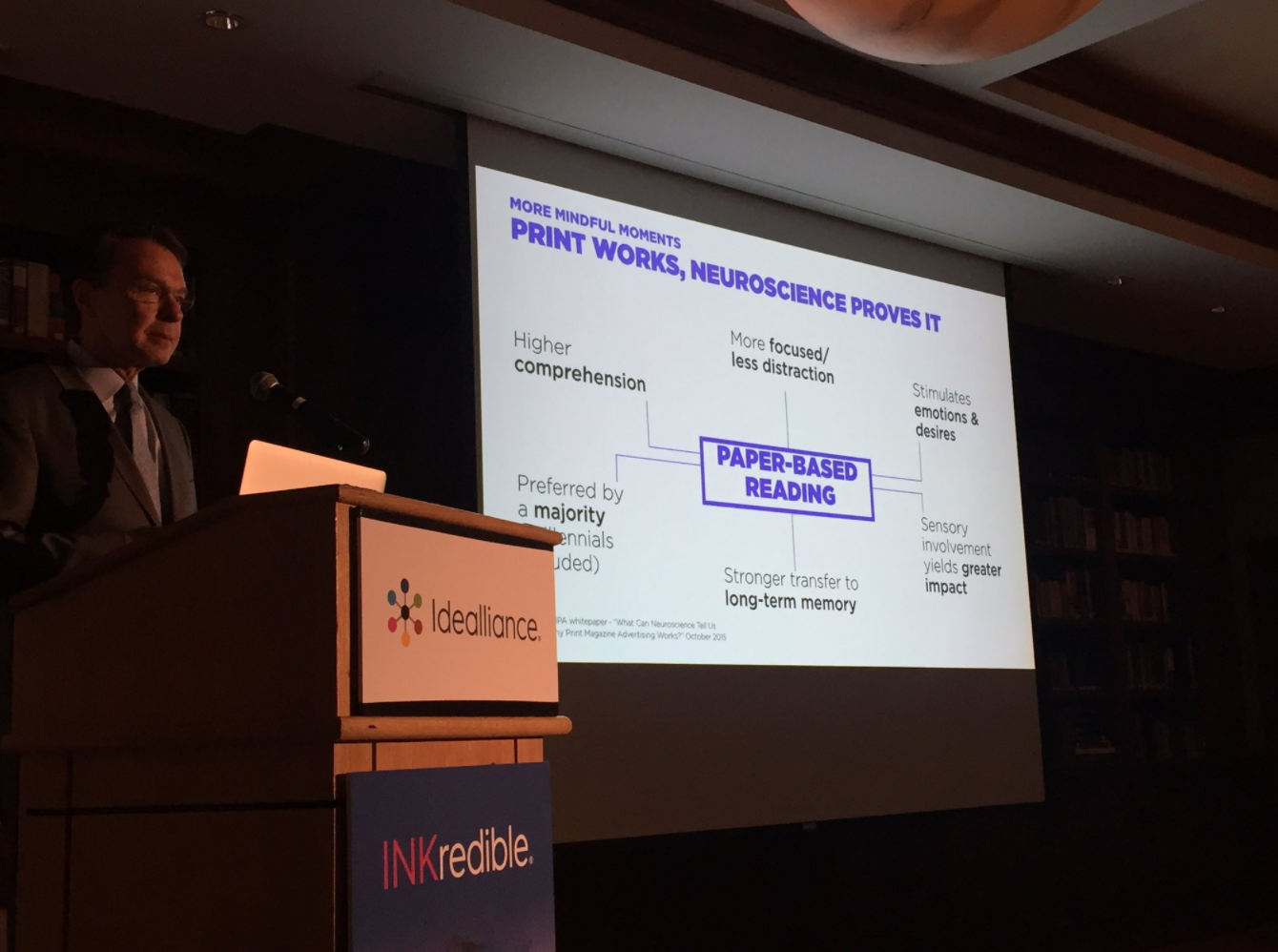
Here is a video interview from the event via What They Think site.
